
The Great Babylon
Law and Disorder in Sixteenth Century Seville

This week marks an unusual chapter in my writing life. This Thursday, on Dec 11, my historical crime novel The Emperor of Seville comes out as a Kindle digital book, published by Sharpe Books. It’s the (belated) sequel to my novel The Devils of Cardona, which was published in America in 2016. Belated is something of an understatement. I mean, we’re talking about nine years here.
That novel was well-received, and sold reasonably well. It picked up some terrific reviews. For example:
What begins as a mystery becomes an adventure, a thrilling quest for justice on more levels than Mendoza (or the reader) expects…in well-structured chapters and harrowing scenes, Carr allows glimpses into the behavior and actions of other characters, ratcheting the tension as crimes are solved and the criminals get their comeuppance…[A] novel that is as exciting as it is enlightening from its first pages to its satisfying end.—The New York Times Book Review
And:
The Devils of Cardona is one of those rare historical mysteries that is as thrilling as it is thoughtful. Aside from violence and philosophy, it encompasses political machinations and sexual intrigue and seems ripe for translation to the screen. In this day and age, its message of religious and social tolerance would be well served by being further disseminated, even as it is already beautifully delivered in this intelligent, entertaining book. —Criminal Element
I’m not here to brag, though of course I was pleased with that reception. That was my first published novel, and I really writing a book which allowed my imagination to roam more or less freely over a period of history that I had previously only written about in non-fiction.
I wrote it with very specific objectives in mind. I wanted to entertain readers and immerse them in the history and culture of sixteenth century Spain, whilst also engaging in a serious discussion about religious persecution and the persecution of minorities; about the treatment of women, and the extent to which every generation and every society is a battleground between tolerance and intolerance, coexistence and violence.
‘Serious’ and ‘entertaining’ don’t have to be mutually-exclusive concepts. DEVILS owed a debt to films like Seven Samurai, The Magnificent Seven, and the formative Westerns of my childhood, with their themes of justice, resistance and oppression. I wanted it to have a Robert Louis Stevenson, Rosemary Sutcliffe and Alexandre Dumas vibe, with murders and intrigue, swordplay and chases, transgressional sex, some seriously bad villains, and heroes who readers could get behind.
Writing that novel also gave me the opportunity to depart from historical source material, and seek imaginative answers to questions that I had often asked myself while writing Blood and Faith: the Purging of Muslim Spain: How did people on the receiving end of such a repressive and intolerant society survive? What were the rules of the time and how were they broken? What did the persecutors and inquisitors think they were doing, and how did they justify their actions to themselves?
What did these sixteenth century Spaniards - Moriscos and ‘Old Christians’ - think, and feel, and how did they speak to each other? What, if anything, could we see of our 21st century selves, in the Spain of the Counter-Reformation, and its destructive obsession with religious purity, heresy and ethnic homogeneity?
DEVILS was never published in the UK, for reasons that I’ve never been able to fathom, though it is now available digitally, with Sharpe Books. But I had always intended to follow it up with a series. In fact, no sooner had DEVILS been accepted than I began writing and researching the sequel, only to find, more than a year later, that my publishing company decided not to take it.
And because they didn’t, no one else picked it up either.
As many (most?) writers will know, this is how it is sometimes. Projects do not always come to fruition. You don’t always publish everything you write, and it doesn’t matter how invested you are in the characters and plot, or how much work you put in. From the moment you set out to publish, you are always operating in a world that you have very little control over.
This means that sometimes you have to say goodbye to - or at least shelve -manuscripts in which you were fully invested while writing them. Or continue writing a book that is destined for your bottom drawer.
In the case of DEVILS and The Emperor of Seville, I was REALLY invested in the characters I had spent so much time with, not only the ones I invented, but the real people who were part of that era, such as Philip II, Cervantes, Saint John of the Cross, and Teresa of Ávila.
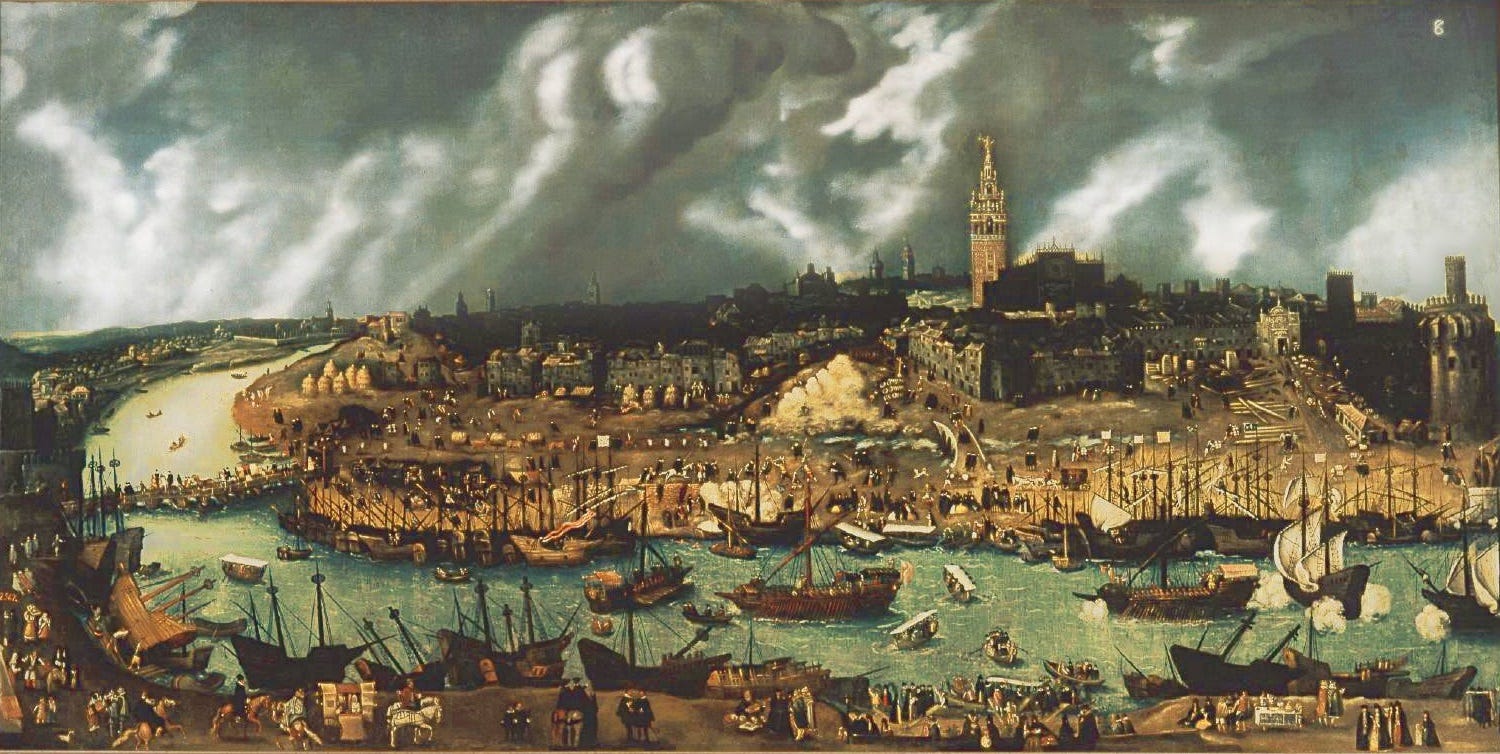
I also had a very specific character arc in mind. Where DEVILS was set mostly in the ‘savage’ Pyrenees, in a rural mountain village in Aragon, EMPEROR was set almost entirely in Seville, the city that sixteenth century Spaniards called the ‘Great Babylon’ or simply Babilonia.
At that time, Seville was the gateway to the Indies, and the principal entry point for silver coming into Spain and Europe. This two-way traffic was concentrated on a miserable strip of sand on the edge of the Guadalquivir River known as the Arenal - the destination and port of embarcation for the Indies treasure fleets, until Cádiz replaced it.
For much of the sixteenth century, Seville was the city of empire - an emblematic product of Marx’s famous depiction of the ‘rosy dawn of the era of capitalist production’ based on:
The discovery of gold and silver in America, the extirpation, enslavement and entombment in mines of the aboriginal population, the beginning of the conquest and looting of the East Indies, the turning of Africa into a warren for the commercial hunting of black-skins
Partly because of its proximity to Portugal, Seville was a multi-racial city with so many slaves that it was known as the ‘chess board’. It also had more than 10,000 prostitutes, some of whom were engaged in semi-legal prostitution in brothels outside the city walls. These ‘houses of conversation’ could be visited by good Catholic men before Mass, provided none of the girls was under the age of 12 or named María.
All this was done with the blessing of the ecclesiastical and secular authorities.
If Seville was associated with dreams of imperial wealth, it was also synonymous with crime and ‘la mala vida’ (‘the evil life). It was awash with men whose dreams of wealth in the Indies had come apart or never taken off. In the patios just off the cathedral, gangsters, hired assassins, thieves, disinherited sons, procuresses and con-men lingered all day long, in search of work, only a few yards away from the trestle tables where bankers and moneylenders organised lines of credit extending across Europe; where slave auctions were held, and sea captains heading for the Indies recruited their crews.
This city of extreme wealth and extreme poverty was the city, where the seventeenth century painter Bartolomé Esteban Murillo painted his marvellous portraits of Seville street children. On the surface at least, it was also a devout city, famous for its Corpus Christi procession; the ultimate test of faith for the Carmelite mystic and reformer Saint Teresa Ávila. It was the location of the royal prison, now a bank, with its savage rules and rituals, where Cervantes spent some time for a minor financial infraction.
Seville also embodied the paradox at the heart of sixteenth century Spain’s transformation from Mediterranean backwater into the Hapsburg global superpower: Spain’s wealth was built on silver from the Indies, most of which was extracted through slave labour. Yet most of the silver that came into Spain went straight out of the country, either through contraband or in order to pay debts to foreign bankers and financial houses.
At various points in the sixteenth and seventeenth century, the Spanish crown was obliged to default on the loans it required to fight Spain’s endless wars.
These contradictions and extremes are all part of The Emperor of Seville. I wrote it in the aftermath of the banking crisis, when another global superpower was discovering, as Spain once did, that there were limits to its military power. The 21st century was very much on my mind in this story of high and low Seville, of corruption, sex and gangsterism.
At the beginning of the book, Cervantes asks the investigating magistrate Bernardo de Mendoza ‘if you you had to decide between the law and justice, what would you choose?’ In a society where justice is often absent, and enforced through terror and violence, Mendoza is forced to answer this question, as he struggles to unravel a series of murders in which the Spanish crown itself may or may not be involved, during the preparations for the Spanish Armada.
Seville was also a city of pleasure - both licit and illicit - and I wanted to capture that flavour, and the city’s appetite for music, commedia dell’arte, and carnivalesque displays of piety.
So you can see why I was reluctant to let this book go. Over the last nine years, I’ve often picked it up and thought that there might be some way to get it out there. And now, I’m pleased to say that it will be live on Kindle from this Thursday, and it will also be available on demand as a print book a week later.
For those who like this sort of thing, I’d like to ask a favour. Because this is primarily a Kindle book, visibility is essential. If 30-40 people buy it in the first 48 hours, Amazon will move it up to a sub-genre category, and this will have a significant impact on its future.
I recognise that some readers may not want anything to do with Amazon. Fair enough, I can understand that. But for those readers who do use Kindle, and think they might be interested to read this book, it would be really helpful if you or someone you know could drop a message in the comments section and commit to buying the Kindle version (it’s not expensive) within those 48 hours, and I’ll send you the link.
Here’s the blurb, and a brief extract to - hopefully - whet your appetite.
BLURB
Summer 1586.
When the Genoese banker Sandro Grandoni is murdered at a trade fair in the Castilian town of Medina del Campo, the Valladolid Chancery appoints the magistrate Bernardo de Mendoza to conduct the investigation.
The murder takes place at a delicate political moment. King Philip II is preparing to invade England, and the crown is negotiating a new loan with the House of Grandoni to help finance the invasion. While the king and his ministers await the arrival of the imperial treasure fleet in Seville, one of Grandoni’s partners is murdered on the banks of the Guadalquivir.
Anxious to eliminate any obstacles to the ‘Enterprise of England’, Philip sends Mendoza to Seville to see if the murders are connected.
Accompanied by his restless ward Gabriel, and a charismatic poet named Miguel de Cervantes, Mendoza travels to the violent, vice-ridden imperial city that sixteenth century Spaniards called ‘the Great Babylon.’
Mendoza soon finds himself entangled a bewildering web of intrigue and corruption, that extends from the Indies to the Seville streets. In an unfamiliar city where no one can be trusted, Mendoza is forced to seek the assistance of his turbulent cousin, Luis de Ventura.
Mendoza’s task is further complicated, when his lover Elena unexpectedly arrives in the city with an Italian theatre group.
Throughout the sweltering Andalucian summer, Mendoza follows the trail of deaths, as the search for justice becomes a struggle for survival, in which no one’s life is guaranteed.
EXTRACT
‘ I don’t know if it’s because of the climate - I always heard that devils were freerer to tempt people there...They certainly came after me, because I’ve never felt more timid or cowardly in my life. I didn’t know myself. ‘
Saint Teresa of Ávila, on Seville
Quién no ha visto Sevilla, no ha visto maravilla - Who has not seen Seville has not seen a marvel.
Old Spanish proverb.
PROLOGUE
Cerro Rico, Potosí, Viceroyalty of Perú, January 1586
FROM THE ENTRANCE TO the smelting yard, Capitán Barragan watched the Indians carry the crates out of the storeroom to the waiting carts. Even in his clothes, the cold cut through to his bones, but many of the Indians were wearing only loincloths or light shirts, and some of them were trembling uncontrollably as they plodded across the dirt yard carrying their heavy loads. From time to time, they raked up a gob of phlegm or hacked out a tubercular cough as they hoisted the strongboxes up onto the carts, beneath the watchful vigilance of their armed escorts. Soon the carts began to buckle and creak as the boxes were piled higher on top of each other, and drivers murmured soothing noises to their restless oxen as the Indians piled the crates still higher.
Barragan sucked deeply on the thin Andean air that never seemed to fill his lungs even after eight months in the viceroyalty, and gazed up towards the lights from the concessions that burned all along the slopes of the Cerro Rico, the Rich Mountain. From a distance it looked as though the mountain itself was a giant hollo w bowl filled with light, but each glowing point marked the entrance to one of the hundreds of mine shafts that penetrated ever- deeper beneath the surface. One day, Barragan thought, the mountain would be scraped clean and there would be no more silver left inside it.
On that day, the world would be a different place, and perhaps it would no longer exist at all. The Indians believed that the Cerro Rico was the home of the deity Pachamama – the Mother of the World. But as he listened to the sounds of the smelting yard all around him, the mountain seemed more like a monster than a goddess. He seemed to hear its hoarse, rasping breathing in the bellows that stoked the mercury ovens; in the groaning and creaking of its joints in the horses and waterwheels that crushed the ore with great wooden beams; in the faintly menacing hiss as the hot ore was flattened out onto the ground and sliced into ingots like pieces of cake.
The capitán dismissed these childish heathen fantasies. Like most of his countrymen, he had never been inside a mine and had no desire to. Only indios and negro slaves climbed down the rickety wooden ladders that led from one ledge to the next. Some of the ladders were tired together and dropped down hundreds of feet before they reached the tunnels where the Indians wasted away their short lives, digging out silver ore with their baskets, shovels and pick axes. Even now Barragan imagined them crawling like glowworms beneath tons of rock and earth, with their baskets and pickaxes, and candles in their mouths. That was not work for Christian men, he thought, as he watched the day workers trudging up the mountainside with their empty baskets around their necks towards the mines where they would spend the next twelve or fourteen hours.
Most of them were peons, who worked for the perfunctory wages the mine owners paid them, ever since the missionaries had managed to persuade the king that Jesus did not approve of taking Indians as slaves. A few even worked extra hours on their own account to sell the ore they found on commission.
Nowadays, there were more and more slaves coming from Africa. Barragan had never understood why it was Christian to enslave negroes but not indios, but theology was not his business, and it was obvious even on a cursory inspection that many of the new arrivals would not live to see the new year. Some of the slaves just arrived from the coast were already dying in their chains as they struggled up the hillside with their overseers riding alongside them, their whips poised on their saddles. Even the strongest would soon be undone by the long hours, the cold and the thin air. From the opposite direction, the night workers were already coming down the slope, hunched forward from the weight of the baskets that hung around their necks, their faces and bodies streaked with dirt, like rows of ants obeying some silent signal that was audible only to them.
Barragan observed all this without pity, because the world was the way it was, and it was the destiny of the weak to submit to the strong, no matter what Jesus said. A gust of wind cut through his cloak and leather jerkin, and he stamped his feet to stop the cold from spreading up through his boots. It was light enough to distinguish the conical outline of the Cerro Rico from the smaller mountain beneath it now, and he murmured some instructions to the leader of the team in Quechua, before walking down past the rows of kilns and workers huts, through the thick forest above the town of Potosí.
After a few minutes he turned off a narrow path that led into the trees. Soon he heard the unmistakable sound of digging and the path gave out onto to a small clearing, where two Indians were knee deep in a rectangular hole that they were digging out with shovels. They might have been two peasants working the land, were it not for the Spaniard in a nightshirt who was tied to a nearby tree with a gag around his mouth. At the sight of Barragan, he let out a muffled cry, and the two Indians paused as the captain walked over towards him.
“Keep quiet and I’ll take it off,” said Barragan soothingly. “Can you do that?”
The captive nodded, and his wild, terrified eyes looked suddenly hopeful as the gag came off. “I beg you sir,” he pleaded. “Don’t do this.”
“I did warn you.”
“For the love of God, sir, I have a wife and children.”
“You should have thought of them before.”
“Please sir.” The prisoner’s jaw was trembling, and tears were flowing down his cheeks. “As God is my witness, I will never speak of this.”
“I know that. Listen.” Barragan raised one finger to his lips. “Do you hear that?”
The prisoner looked to one side, as an unseen bird from the edge of the clearing emitted a high-pitched chirruping sound that ended in a whoop. Barragan smiled happily. “It speaks Quechua. Do you know what it’s saying?” The prisoner shook his head. Barragan placed one hand over his mouth, leaned forward till his lips were almost touching the terrified man’s right ear, “And the Lord God planted a garden in Eden, in the east,” he whispered. “And there he put the man whom he had formed.”
Barragan drew the dagger with the serpent-shaped handle from his belt and thrust it upwards into his prisoner’s heart. Even after killing so many, he still felt the same fascination and wonder, as the prisoner breathed his last gasping breath into his hand and slumped forward over the rope. Barragan stooped to wipe his blade on the wet grass. All around him, the life of the forest was beginning, just as it had on the very first day in the history of the world. The birds were whooping and chirruping from the dripping green wall, and through the mist above the trees, he could see the sun emerging through the clouds at the beginning of a new day. He handed two silver coins to one of the peons and walked back through the dripping forest and towards the yard, where the wagons were waiting to take him on the long journey home.
I just might buy it. Lots of themes there (I’ve just read a book on Lepanto too). Being your age, I’m into ebooks (kindle is their device name; don’t get misled - bit like ‘Hoover’ and ‘vacuum cleaner’). I can change brightness and font (I’m having to give away books whose font is now unreadable).
I do however absolutely loathe ‘smart’phone keypads.
Hi, I'd be interested, thanks =0)