
World on Fire
The Future is Here

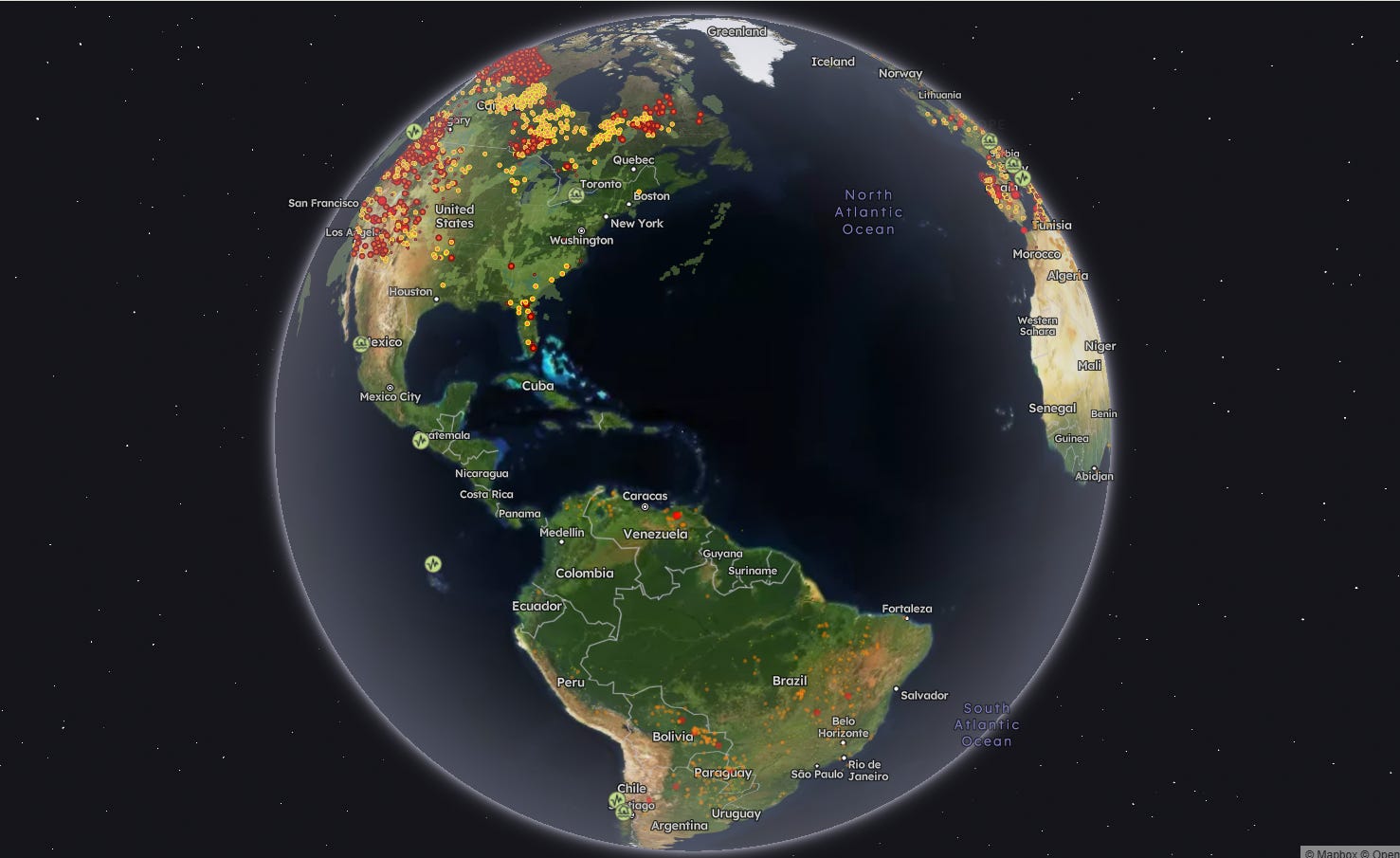
Writing always requires an element of faith, that if you can find the right words, they might resonate and lead to some positive outcome somewhere, or help bring about a moment of clarity between writer and reader. But it’s difficult to find words that can convey the magnitude of the catastrophes that are now bearing down on the world, even more quickly than some of those who once warned about them predicted.
The environmental historian Stephen Pyne coined the term ‘Pyrocene’ to describe the present era of ‘ecological blowback’, in which fossil fuels, industrialisation, agricultural methods and climate change all combine to produce ‘uncontrollable conflagrations.’ In 2024, Pyne described the wildfires in Canada and the United States as evidence of a ‘fire age in which ancient prophecies of worlds destroyed and renewed by fire have become contemporary realities, even for people living in modern cities…Mythology has morphed into ecology. We’re witnessing a slow-motion Ragnarok—a story from Norse mythology in which a great battle burns the world.’
Two years later, that battle is still raging. By July 28, 173,000 hectares had been burned in Spain - a sixfold increase compared with the same period last year, and 35 fires had been reported compared with seven in 2025. In France, between 98,000 and 100,000 hectares had burned by July 25-25 - the worst wildfire season on record - and more than 220,000 people had been evacuated from the Gironde region. In total more than 320,000 people were evacuated from France and Spain. In Suffolk, a wildfire came close to a nuclear power station.
Wildfires have also burned in Algeria, Tunisia, Morocco, Greece, Portugal and Canada. These fires have multiple causes, but most scientists believe that they are intensified by droughts and higher temperatures due to climate change, and that climate change has increased their frequency, and destructive power, whether in the United States or across the world.
Some fires have been so large that they have generated their own weather systems, and the summer is not yet over - a summer that is already hotter than all the record-breaking summers that we have already experienced. In Europe, an estimated 16,000 heat-related deaths have occurred this summer. In India, excess deaths have been estimated at 3, 400 a day
in effect, the 2026 wildfire seasons is both a symptom and a cause of our overheating planet. These fires have taken lives, destroyed homes and livelihoods, and devastated ecosystems and habitats. They are likely to disrupt food production, at a time when food security in many countries is already threatened by droughts and megadroughts, desiccation and war.
The January 2025 wildfires in Los Angeles wildfires destroyed over 16,000 structures and killed an estimated thirty-one people. Economic losses were estimated at $250 billion and insurance companies paid out $40 billion - the largest insurance loss from any wildfire anywhere in the world. As the Yale Law Journal warned, these climate change-related fires are leading towards an ‘uninsurable future’ of ‘more severe and more frequent weather-related disasters, which damage and destroy home and business property and contribute to record insurance-company losses.’
This future is not only bearing down on the United States. Other countries may also reach the point when insurance companies no longer pay out in response to homes and businesses destroyed by wildfires or floods.
No one knows what happens then. Maybe governments will step in, or individuals will simply be abandoned in houses that they cannot pay for and cannot sell, while others are forced to pay premiums that they can’t afford. But if insurance companies refuse to bear the costs of climate change risk, then it will usher in a range of negative possibilities that the financial system seems totally unprepared for.
We have been warned repeatedly that the things that are happening in front of our eyes would happen. We knew we needed to reduce emissions, that we had to think of security not in terms of traditional national security models based on defence budgets, weapons systems and standing armies, but on the more complex and collaborative international arrangements that collective security requires.
We knew we needed to repair and restore the natural spaces that humanity has damaged or destroyed, and prevent further devastation. We knew we had to think differently about conservation, food production, management and water usage; about where we built houses and how to build them. We knew we had to accept ‘limits to growth’, as the Club of Rome warned as far back as 1972.
We knew this, but we didn’t want to believe it. And so we postponed solutions or cut corners. We allowed ourselves to be outlobbied by fossil fuel companies. We allowed far-right populists – many of whom were funded or part-funded by fossil fuel money - to accuse scientists of perpetrating a ‘climate change scam’ or pursuing a ‘woke’ policy of net zero.
In the US, 77 million Americans voted for a president who told the United Nations General Assembly in September last year that climate change was a ‘con job’ made by ‘stupid people’ and that green policies were a ‘scam’. Millions preferred to listen to ‘climate sceptics’ who foamed through X in the wake of Musk’s takeover, and nodded happily when Jordan Peterson described ‘net zero alarmism’ as a ‘mental illness’ and Joe Rogan said that the planet was cooling, not heating.
Because why believe ‘experts’ or the scientists from the IPCC when you’ve got a dope-smoking podcaster to do the work? Who wants to listen to the Spanish prime minister Pedro Sánchez - Communist! Woke! - who last year attributed Spain’s wildfires to the ‘climate emergency’ and has called repeatedly called for a cross-party ‘State pact’ to address it? Of course this invitation has been turned down by the Partido Popular and Vox, both of whom condemn the ‘climate fanatics’ and ‘saloon ecologists’ who connect the wildfires to climate change.
Last week the Telegraph published an editorial by Allister Heath suggesting that the UK should give up trying to fight climate change and embrace a ‘Mediterranean lifestyle.’ Yesterday, the same paper carried an opinion piece by Jordan Peterson proclaiming: ‘Climate change dogma is a Leftist weapon to destroy capitalism.’
Conservative leader Kemi Badenoch has said that no one promoting net zero can be a candidate for her party. Last week, Badenoch wrote a letter to the Telegrpah admitting that ‘climate change is real’, but still held onto her no net zero pledge. This partial row-back was a response to an article by Ambrose Evans-Pritchard in which he accused her of ‘climate nihilism.’
Badenoch isn’t the only one to suffer from this affliction. In Newcastle-under-Lyme, the Reform-led Borough council axed the council’s climate emergency declaration, which its leader Jonathan Gullis called ‘political virtue signalling’. In Suffolk, the Reform-dominated county council voted last month to rescind the council’s climate emergency declaration and remove its ‘performative’ net zero targets in favour of ‘common sense’ – only weeks before wildfires devastated Dunwich Heath.
These people are not your friends, yet still they get votes, because culture wars are so much easier, and so much more fun, than climate change. And it isn’t only the right that refuses to look. Keir Starmer twice suppressed plans to publish a UK military and intelligence report in full, on the potential impact of climate change on the UK’s security and food supply in as little as five years.
According to the Guardian’s Fiona Harvey, even the shorter version ‘paints a devastating picture of severe food shortages, price rises, migration, political destabilisation, and possible war, resulting from the collapse of ecosystems, fuelled by the human-induced climate crisis and over-exploitation.’ The longer version was suppressed, because Labour was concerned that Reform would attack the government for putting ‘climate concerns ahead of the cost of living.’
So far Andy Burnham has not released that report either, because even for a prime minister who wants to be honest with the British people, some truths are too alarming to be told. Such anxieties demonstrate the deadly stranglehold that the right and far right exert over British politics and in many other countries, and they also reveal how even mainstream governments cannot or will not face up to the magnitude of the climate emergency and the transformations that it requires.
In an interview earlier this month, the veteran environmentalist and climate change campaigner David Suzuki told his interviewer that it was ‘too late’ to prevent the catastrophic consequences predicted at the 1988 Toronto Conference on the ‘Changing Atmosphere: Implications for Global Security’. This provoked the following exchange:
Q. You say we’re too late to address climate change? That’s a pretty stark quote. Does that mean you’re giving up on the fight?
A. I’m not giving up on the immediate years, but the focus on politics, economics, and law are all destined to fail because they are based around humans. They’re designed to guide humans, but we’ve left out the foundation of our existence, which is nature, clean air, pure water, rich soil, food, and sunlight. That’s the foundation of the way we live and, when we construct legal, economic and political systems, they have to be built around protecting those very things, but they’re not.
Because the world has not established these systems, Suzuki argued, it is no longer possible to prevent climate change, and strategies for survival need to shift towards adaptation and resilience. It is difficult, faced with this summer’s cascade of disasters, not to reach similar conclusions. But as Suzuki also made clear, adaptation is not the same as passivity or acceptance.
So mourn the homes that have been burned this summer, the lives that have been lost and the habitats that have been destroyed. Celebratedthe firefighters, both professionals and volunteers, who have spent all summer putting these fires out. But let us stop indulging the bought-up ‘contrarians’ and influencers, and the drooling oligarchs who leer ‘drill baby drill’ like drunks at a strip show, even as the planet burns.
Be revolted by all means by their nihilism, their greed, their stupidity, selfishness and and cynicism. But the supposedly sensible politicians who stand blinking in the headlights of catastrophic systemic breakdown are no less culpable in their cowardice. We need the serious response to the climate emergency that Sánchez called for.
We won’t have a chance of getting one if governments refuse to tell the public what it needs to hear: that this summer of fires may only be the harbinger of much worse to come, and that there will come a point - possibly sooner than we think - when all these crises overlap and reinforce each other.
We should be afraid of that possibility, because it is terrifying, heartbreaking and tragic. But we shouldn’t let it paralyse us. In a (paywalled) op ed. in Le Monde, French sociologist Benoit Giry argues that disasters don’t necessarily lead to long term systemic changes. Such changes require deeper and wider political work across the whole of society. Nevertheless, Giry argues:
The world as it is now is not sustainable. Radical changes to our way of life are underway and will eventually come to pass. But in which direction will they go? Toward greater solidarity or toward more competition between individuals and social groups? Toward increased exploitation or toward a more sustainable management of environmental resources?
These are the questions that must be answered in the coming years - the sooner the better, and the way we answer them will decide whether or not this planet continues to burn in the years to come.
This: "But let us stop indulging the bought-up ‘contrarians’ and influencers, and the drooling oligarchs who leer ‘drill baby drill’ like drunks at a strip show, even as the planet burns."
Once again Matt Carr informs and terrifies. But are our leaders listening. When Andy Burnham say yes to drilling, we'll know he isn't serious about leading with courage ... but he may prove us all wrong .. he may say no to corporate greed and populist and start on the real path to sustainable change. We can but hope!