
On Thin Ice
The Spectres at the Davos Feast

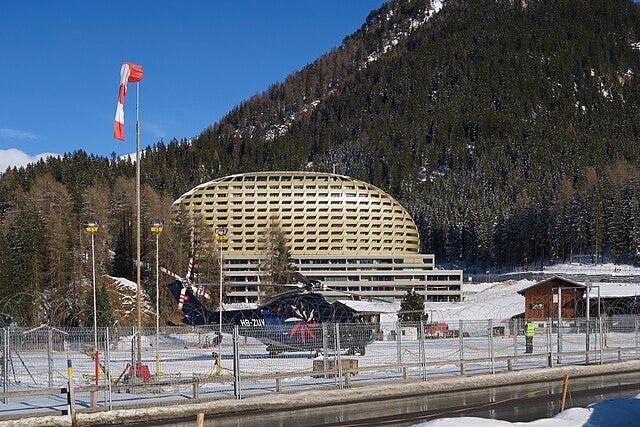
Last week, the news cycle was dominated, as it often is at this time of year, by the World Economic Forum annual conference at Davos. Normally, this is a sedate event, in which world leaders, bankers, billionaires, and assorted celebrities helicopter into the Swiss resort to take the temperature of our troubled world. It’s the 21st century version of The Magic Mountain - an alpine retreat where big ideas are debated by big people, in an atmosphere of conviviality and mutual respect.
But this year’s Davos has been surprisingly fractious. Gavin Newsom calling European leaders ‘pathetic’ for not standing up to Trump; heckles and boos during the oafish US Commerce Secretary Howard Lutnik’s dinner speech; Christine Lagarde walking out of the dinner; Nigel Farage on a billionaire-funded jolly smirking against a snowy backdrop as he promised to liberate the UK from the ‘globalists’ - Hans Castorp would have caught the ski lift straight back down.
And then, there was was the clown-criminal president of the United States. On Wednesday, Trump came shambling into Davos with a malignant, lying, rambling speech that was shameful even by his shameful standards. In addition to the usual bragging about his ‘achievements’, he attacked Ilhan Omar and other ‘low IQ’ Somali-Americans, and chided Europeans allowing parts of Europe to become ‘unrecognisable’ (Clue: too many black and brown people).
At a time when ICE agents in Minneapolis are killing Americans in plain sight, arresting children and terrorising communities, he praised his paramilitary goon squads for removing immigrant ‘murderers’ from the US, and bragged about ‘blowing away’ Venezuelans on the high seas with the sadistic relish of a psychotic high school shooter.
But he did at least rule out using force in Greenland, which was something of a climbdown, even if he pretended otherwise. It was barking, spittle-flecked nonsense that made a mockery of sense, decency or anything even approaching statesmanship. In electing a man like this to be their leader in the belief that he would make their country ‘great again’, Americans have ushered in a phenomenon unprecedented in history: the implosion of a global superpower entirely through its own stupidity and its own efforts, unfolding in real-time.
All empires collapse in the end, but it normally takes much longer for the decline to become apparent and irreversible. Under Trump, the ‘liberal empire’ constructed by successive American administrations since World War 2 is unravelling like a speeded-up film. Yes, the US remains the dominant global military power, with the ability to send ‘armadas’ to the Persian Gulf, bomb any city anywhere and kidnap whatever world leader it wants. And the dollar remains the main global reserve currency - for now.
But contrary to Mao’s famous dictum, American power did not simply descend from the barrel of a gun. It was dependent on alliances, relationships built on trust, interdependency, skilled diplomacy, and at least the illusion of shared values and a common moral and political purpose.
Under Trump, all this has been shattered. And as for primacy of the dollar - that also requires trust and reliability and competence, which is being trashed, as the US makes threats it cannot enforce, imposes tariffs on its own allies, then reverses them, and then imposes them again.
It’s an outcome that would have given Talleyrand, Metternich or even Palmerston a coronary, and America’s allies are not coping well with it. Too many governments have tried to carry on as normal, or cling on to what vestiges of normality remain. Some have sought to master the art of ‘Trump whispering’ - seemingly oblivious to the fact that Trump is merely the wrecking ball of choice for a wider movement that sees American dominance solely in terms of raw power.
But last week, Mark Carney, the prime minister of Canada and former president of the Bank of England, finally broke with that consensus. At the talking shop of the World Economic Forum, Carney did what no other world leader has done, and declared that the facade of normality can no longer be maintained, and the United States can no longer be trusted as a strategic partner.
The Rupture
It’s not difficult to deliver a better speech than Trump - a primary school debater could do that. But Carney’s speech combined an intellectual heft, incisiveness and sophistication, with strategic vision - a combination that has been almost entirely absent amongst European and British politicians of both left and right for many years.
Carney essentially claimed that the ‘international rules-based order’ was a ‘fiction’ that has reached the point of ‘rupture, not a transition.’ In this new world in which ‘great powers have begun using economic integration as weapons, tariffs as leverage, financial infrastructure as coercion, supply chains as vulnerabilities to be exploited,’ Carney told his audience, ‘You cannot live within the lie of mutual benefit through integration when integration becomes the source of your subordination.’
Carney went on:
And there's another truth: if great powers abandon even the pretense of rules and values for the unhindered pursuit of their power and interests, the gains from transactionalism will become harder to replicate.
In these disadvantageous circumstances, Carney spelt out what ‘middle powers’ like Canada could do, in order to remain ‘both principled and pragmatic. Principled in our commitment to fundamental values, sovereignty, territorial integrity, the prohibition of the use of force except when consistent with the UN Charter and respect for human rights.’
In setting out a new path for his own country, Carney suggested that these principles could become the basis for a coalition of ‘middle powers’ working ‘issue by issue with partners who share enough common ground to act together.’ Such a coalition was required because:
When we only negotiate bilaterally with a hegemon, we negotiate from weakness. We accept what’s offered. We compete with each other to be the most accommodating. This is not sovereignty. It’s the performance of sovereignty while accepting subordination
It is easy to pick holes in these arguments. Some might point out that many countries in the global south have been in the situation that Carney describes long before America lost its mind. Or the many things that the international rules-based order has not been able or willing to prevent or even condemn: illegal US extrajudicial executions in the Caribbean; the colonisation of the West Bank; the merciless annihilation of Gaza.
In the same week that Carney gave that speech, Israel demolished UNRWA headquarters in East Jerusalem. Though the UNRWA commissioner general Philippe Lazzarini condemned what he called ‘an unprecedented attack against a UN agency and its premises’, there was not a word of criticism from Canada or any other signatory to the UN Charter.
Before his speech Carney had accepted, in principle, an invitation to join Trump’s obscene ‘Board of Peace’. Originally set up to oversee the reconstruction of Gaza - it is now rapidly evolving into a billionaire/autocrat/mafiosi alternative to the UN, and a machine for the further enrichment of the Trump family. The day after his speech, Trump announced his own ‘charter’ and his plan to extend the ‘Greatest and Most Prestigious Board ever assembled at any time, any place’ to other conflict situations.
No one can be surprised that Tony Blair has joined this gathering of the damned. Blair would picnic in hell with Satan if he thought that there was money and prestige in it. But why did Mark Carney give his conditional acceptance to an invitation that has also been extended to Putin, Lukashenko and Netanyahu, and which may require a 1 billion dollar entrance fee? If ‘middle powers’ are to uphold the UN Charter, why not actually do that? And how does participation in the plainly ‘hegemonic’ board of peace enable Canada to extract itself from the tentacles of the hegemon?
The criminal madman has now withdrawn his invitation, as a result of Carney’s ‘ungrateful’ speech in Davos Given these contradictions, it would be overstating it considerably to call Carney’s speech a manifesto of resistance. There are issues it does not raise, and problems it does not address. But it is a powerful and unambiguous rejection of American dominance, based on a clear-eyed and unsentimental assessment of the new geopolitical reality.
Carney spoke as the leader of a country that has begun to seek new strategic and trade partnerships with China, India, the Philippines and Mercosur, and which is attempting to build a trade bloc between the Trans-Pacific Partnership and the EU.
All this amounts to an implicit rejection of the Pax Americana, to which Canada is unlikely to return even if its neighbour changes government. And Carney’s speech was also a public acknowledgement that America is an unreliable partner and a greater strategic risk than China - America’s principal economic rival. If Canada can seek new trade relationships with China, regardless of American threats and bluster, then other countries can do the same.
Much of what Carney said about subordination, performative sovereignty and ‘middle powers’ applies to the Europe, and particularly to the UK. The British government has persistently tried to normalise the abnormal in its dealings with Trump, and clung onto the illusion of a special relationship that no longer exists, if it ever really did. Until last week, it has attempted to avoid confrontation or even criticism of the US, alternately flattering the gangster-king, or attempting through diplomatic alchemy to avoid precisely the kind of ‘rupture’ that Carney described.
Last week, Starmer finally showed something like defiance, following a brazen attempt by Trump to humiliate him over the Chagos Islands. But despite his forthright commitment to Greenlandic sovereignty and international law, Starmer and his team still insisted on the need for calm, in response to Danish and European discussions of reprisals for Trump’s tariffs.
The hotheads are not on this side of the Atlantic. Yet the day after Trump’s climb down from the threat of military action in Greenland and his withdrawal of the tariffs, Starmer attributed these results to ‘a mix of British pragmatism and common sense.’ I very much doubt whether the UK’s European neighbour will appreciate this self-congratulatory assessment of our national characteristics, which have been conspicuously absent for some time.
Denmark’s plans to sell US Treasury Bonds; the EU’s threat of retaliation; falling stock markets; the unified response to Trump’s threats from the EU, Canada and the UK - all these factors are likely to have had far more impact on the American turnaround than British sang froid.
It is foolish and ridiculous for Starmer to pat himself and his country on the back, just because the madman and his minions have suddenly decided to accept a ‘deal’ in Greenland that the US could have had all along. As for ‘calm’, Carney spoke calmly and made coherent arguments which you can agree or disagree with, but which are almost impossible to imagine from the current British government or its predecessors. Some may insist that the UK is too weak to talk like this, and such arguments are not without foundation. Isolated and damaged Brexit and still too frightened to address that mistake, the UK is a ‘middle power’, hovering uneasily between Washington and Brussels.
But Canada is no less vulnerable than the UK. It lives next-door to an ally-turned-predator that is openly threatening annexation, or economic blackmail. But unlike the UK, Canada has taken steps to extricate itself from this relationship and redefine its national interests in a world in which America can no longer be relied on.
The UK still clings onto the old world that Carney described last week. It is still trying to be Greece to Rome, even when Rome is ruled by Caligula and Commodus. And unless that changes, the UK will very likely have a Farage government that will give Trump anything he wants.
It will take more than delusions of ‘British pragmatism’ to prevent that outcome. You cannot keep inviting a guest to dinner, when he behaves like a drunk in a bar, brandishes a broken bottle, and smashes up the furniture.
The day after Starmer was congratulating himself, Trump mocked NATO troops for not being on the frontline in Afghanistan. This was too much even for Starmer, who publicly rebuked the gangster-king and pointed out that UK troops took 457 casualties ‘fighting for freedom’ - as part of the ‘special relationship.’
That’s one interpretation of the disastrous British deployment in Helmand, but however you interpret it, the casualties were real. Trump walked back his insult, but this ‘spat’ won’t be the last. As Carney pithily put it last week, with regard to middle powers that fail to act collectively in defence of their mutual interests, ‘if we’re not at the table, we’re on the menu.’
This is the new world in which the UK now finds itself. It remains to be seen whether the British government continues to hug the mad king in the hope that he loves us back, or whether this country can wean itself off a flailing superpower, and seek its future elsewhere.
Agree with every word - Carney finally called out that the Emperor has no clothes. That the old age is over and that we should stop pretending. We can only hope that other leaders get the message and start to do the same. Carney and Canada have moved on and are now starting to put in place specific actions to deal with a post-American world. China being a very significant move.
Im pretty sure that Zelensky gave up a long time ago and that Ukraine has been building the capacity to fight without US support for the last year. The UK and Europe have to do the same as Ukraine and Canada. They might continue with bland words to Trump but behind the scenes they need to be actively building the structures and capacity to operate defensively and economically with minimal US support.
The scale of ICE and its modus operandi give the lie to it being about immigration. This is the Trump regime's enforcers, built to suppress any and all opposition, aided and abetted by a compliant media, co-opted state institutions and a business community driven by fear and greed. No evidence that the military will do other than follow his orders, even if that means firing on their own citizens. Trump and his regime know that they will be held to account in no uncertain terms if they lose power. They have no intention of losing it. Ever. Unless dragged out.
My respect and pity goes to those brave people on the streets of Minneapolis. Now looking ever more like Iranians facing their government. Or Palestinians facing Israelis. We are no longer exaggerating. I especially despise all those American leaders who are doing nothing, out of fear and greed.
The next UK general election is not due until 2029. Given the deep unpopularity of the current government, bringing it forward is highly unlikely.
So the planet will thankfully be spared the prospect of a Trump-Farage alliance.
And given the relentless tide of sleaze that threatens to engulf "Reform UK" and its leader, the British political landscape may well see further dramatic transformations anyway.