
Iran in Flames
And Help is (Not) on its Way

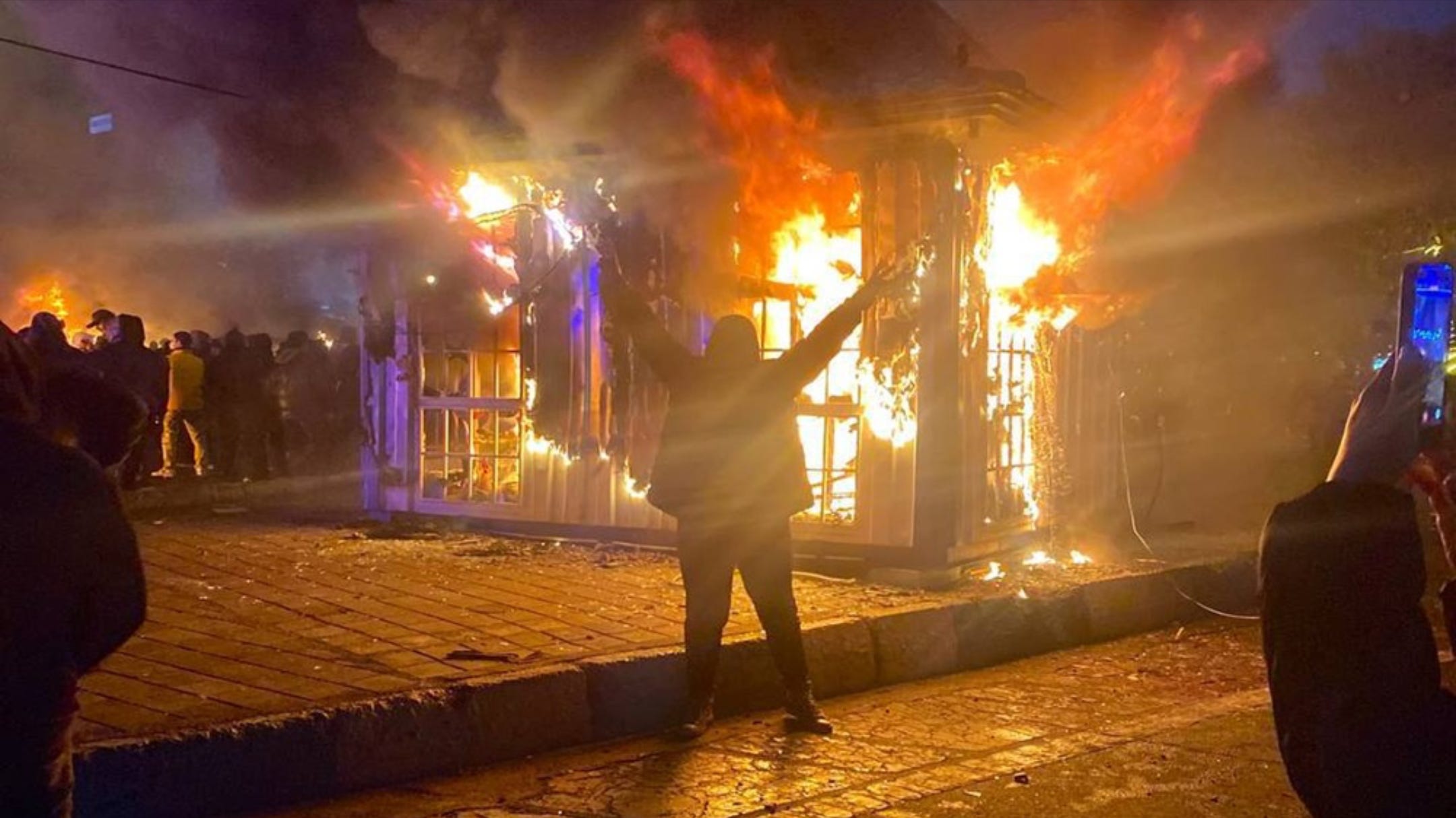
Whatever human rights abuses are taking place elsewhere in the world, there are some countries that will always elicit a very specific moral outrage from Western governments, and the response to the Islamic Republic of Iran’s vicious crackdown on anti-government protesters belongs firmly to this tradition. On January 2, Donald Trump tweeted:
Iran shots [sic] and violently kills peaceful protesters, which is their custom, the United States of America will come to their rescue. We are locked and loaded and ready to go
At the beginning of last week, Trump was inciting protesters in Iran to ‘keep protesting’ and ‘take over your institutions’ in much the same tone that he once used to incite the January 6 assault on the Capitol building. This was the same week in which an ICE agent ‘violently killed’ a female protester in Minneapolis - a woman his government called a ‘domestic terrorist’ and a member of a ‘sinister left-wing conspiracy’.
Nevertheless, Trump promised the Iranian protesters that ‘help was on its way’ if the regime executed any more people. He then rowed back on this pledge, claiming - somewhat improbably - that Iran had promised him that it would not carry out any more executions. In this country, Foreign Secretary Yvette Cooper summoned the Iranian ambassador to condemn the regime’s ‘brutal’ crackdown. Cooper expressed the UK government’s ‘total abhorrence at the killings, the violence, and the repression we are now seeing’ and promised to implement more sanctions.
Such moral outrage hadn’t been seen since last year, when the Labour government summoned the Israeli ambassador to condemn the brutal slaughter in Gaza and expressed its total abhorrence at what genocide scholars were depicting as an ongoing genocide, taking place in front of our eyes.
Except, as most readers will know, that didn’t happen and never will happen. The President of the European Commission Ursula von der Leyen also condemned the ‘horrifying’ killings of protesters, and ‘unequivocally’ condemned the ‘excessive use of force and the continued restriction of freedom.’
These are strong words, steeped in moral clarity. Was Israel’s use of force in Gaza as excessive? Was it possible to condemn burning alive women and children in hospital beds or shooting people collecting food unequivocally? Was the Egyptian ambassador summoned to Downing Street when Abdel Fattah al Sisi’s police killed between 600 to 2,600 supporters of ousted prime minister Mohammed Morsi on 14 August, 2013?
You know the answers. And where governments go, the pundits will follow. And so the Iranian crackdown has been the object of furious condemnation from commentators who were either silent or equivocal about the hideous slaughter that has unfolded in Gaza for more than two years, and which, despite the grotesque ‘ceasefire’, is still ongoing.
As always, whenever regime change is in the air, condemnations of Iranian repression are accompanied by the invocation of universal values: human rights, feminism, and democracy, and also denunciations of the left’s moral turpitude. Thus The Atlantic laments ‘The silence of the left on Iran’, while the National Review condemns the fact that ‘Iranians are being massacred to the sound of progressive silence.’ Sharing a picture (taken in Canada) of a woman lighting a cigarette with the burning picture of the Iranian Supreme Leader Ayatollah Ali Khamenei, Joanne Rowling tweeted:
If you claim to support human rights yet can’t bring yourself to show solidarity with those fighting for their liberty in Iran, you’ve revealed yourself. You don’t give a damn about people being oppressed and brutalised as long as it’s being done by the enemies of your enemies.
And in the Guardian, Jonathan Freedland had much the same message:
Many of those who usually pride themselves on their solidarity with the oppressed of the Middle East have been uncharacteristically restrained this time and oddly quick to move on, perhaps reluctant to be too hostile to an Iranian regime that defines itself as the foe of the US and Israel. Maybe they think that any enemy of Trump’s is automatically a friend of theirs. Maybe they fear it weakens their support for the Palestinians to oppose a regime that wants to see Israel destroyed.
That last tortuous sentence - with its implication that Palestinian supporters and Iran are motivated by a shared desire to see Israel ‘destroyed’ - reeks of bad faith, and he isn’t the only one. ‘Dear Israeli left - look at Iran,’ blogged ‘recovered antisemite’ Rawan Osman in the Times of Israel. It goes on and on, as it always does, and anyone reading these screeds would be forgiven for thinking that ‘the left’ has enabled the repression merely through it ‘silence.’
Behind the moral fervour and the genuine (sometimes) outrage and disgust at the regime’s brutality, it’s difficult not to detect an unseemly satisfaction about the way these commentators berate the left for its selective compassion, and for not caring as much about Iranians as much as they loudly proclaim.
We’ve been before, in Afghanistan, Iraq, Syria and Libya, and we will be there again, every time regime change rears its head. Are such criticisms justified? Has the left abandoned Iran’s protesters to their fate, while the likes of Trump, Elon Musk and even Netanyahu want to save them?
Firstly, ‘the left’ has no power to shape the outcome in Iran one way or another. Nor is ‘the left’ just one thing. Socialist Worker, for example, has stated clearly that ‘Socialists should back the Iranian protests - and stand for the defeat of the US if it launches military intervention.’ Yesterday, the Morning Star carried a sympathetic interview with a leader of Iran’s Tudeh party, expressing solidarity with the protesters in no uncertain terms, and analysing the causes of the uprising.
So no ‘silence’ there. On social media, I have seen comments attributing the protests in Iran to a US/Mossad black op - essentially the regime’s line too. Others have claimed that the crackdown has been exaggerated. In a Facebook post, Yvonne Ridley, sneered at the ‘English-speaking intellectuals of north Tehran’, for ignoring the fact that ‘millions of working class people still support the government of Iran.
On her website, Caitlin Johnstone berates leftists and anarchists who ‘cheer on regime change in Iran’:
Is there anything more undignified than “leftists” and “anarchists” who cheer on the fall of empire-targeted governments even as the empire moves war machinery into place?
Ooh look at me I’m sticking it to the man by supporting the same agendas as the US State Department. I’m being punk rock by regurgitating the same war propaganda talking points as John Bolton
Johnstone’s argument is more sophisticated than this sneering tone would suggest. Her argument is basically this: Iran is one component of the ‘axis of resistance’ to US imperial/Israeli domination of the Middle East. Because, in her view, there is little or no possibility of an alternative government emerging from the current political unrest, then the Islamic Republic it is, regardless of what it does.
In other words, this is a kind of leftist realpolitik - as in ‘they may be tyrants, but they’re our tyrants’. Johnstone is not wrong to call ‘The premise that the fall of an authoritarian government is always inherently positive’ into question. But her suggestion that the Islamic Republic is not ‘entirely flawless’ is understating it considerably. No one knows for sure how many have died in the last two weeks, but estimates hover between 2,000-12,000. Even Ayotollah Khameni admits that thousands of people have been killed, though he attributes these deaths to rioters influenced by Israeli or US propaganda.
This is not the first time the Iranian regime has drowned opposition in blood. Up to 30,000 executions in 1988; the killing of schoolgirls in 2922, including mass poisonings, and many, many acts of state violence reaching all the way back to the formation of the Islamic Republic - this is a lot swallow in the name of ‘resistance’ is a big ask.
It’s also worth pointing out that the people being killed are not just the people the left doesn’t like - not that that would be an excuse for killing them There are many Iranians who oppose the regime. For example, in December the regime arrested leftist intellectuals, translators and publishers before the protests had taken off. The opposition now extends to the Tehran Grand Bazaar - the tradition death knell for unpopular Iranian regimes in the past. None of this is surprising. As the Economist (paywalled) notes:
Since July the rial has plunged by 40% and hit an all-time low, which sent the price of imports soaring. Annual inflation is nearly 50%. Almost one-third of Iranians live in poverty. Professionals linger outside butchers hoping for scraps. Just a third of working-age adults are employed, says the World Bank. Iran’s economy was forecast to slump by 1.7% in 2025. And that was unevenly distributed. The service sector, which employs half the workforce, is shrinking, as is agriculture. Construction, mostly carried out by military firms, grew.
Not all of this is the regime’s fault. Sanctions have hurt ordinary Iranians, and they were meant to hurt them. The water crisis - due to a prolonged drought and exacerbated by poor management - is another calamity, exacerbating and compounding everything else. Iran’s young population (42.5 % is under the age of 25) is clearly eager for freedoms that the regime cannot give them, without changing its fundamental character.
So there are very good reasons for these protests, and there are very good reasons to condemn a state that is repressing them with extreme violence. But as has often been the case in the past, the ‘why doesn’t the left care as much as we do’ accusations are sterile and generally self-serving. In practice, we are all ‘selective’ in the political choices we make and the states we condemn, and the priorities we give to these choices. This applies as much to those who have shown solidarity with the Palestinians as it does to those who have not, and who are now attempting to turn Iran into a litmus test of moral probity.
How many of those who have condemned Israeli actions in Palestine or failed to do so, condemned or protested the innumerable atrocities in the Democratic Republic of Congo, Ethiopia, Uzbekistan, or Sudan and South Sudan, over the last three decades - to name but a few? And how many of those who supported the invasion of Iraq or Afghanistan were equally ‘silent’ about the crimes carried out in countries where regime change was not an option?
I can’t speak for the left, but speaking for myself, I fully condemn the killing of protesters in Iran, and I fully support the right of the Iranian people to overthrow their government, whilst also recognizing that the Iranian people are not one thing, and that what some Iranians want does not oblige me or anyone else to share their particular aspirations. There are many Iranians, for example - no one knows how many - who support the return of the Pahlavi dynasty.
Who remembers Operation Ajax, the 1953 CIA/M16-backed coup - actually two coups - that brought down Mohammed Mossadegh’s government, for having the temerity to overturn a dubious oil agreement, signed more than half a century before, and nationalise the Anglo-Iranian Oil Company? Or Hossein Fatemi, Mossadegh’s outspoken foreign minister, who called the Shah a traitor when the Shah temporarily fled the country, only to find himself in front of a firing squad when Mossadegh’s government fell and the Shah returned?
The overthrow of Mossadegh was partly about oil, of course - if it wasn’t for that, Iran would have no interest to the countries that destroyed his government - and it was partly motivated by American fears that Mossadegh was too close to the communist Tudeh party. Iran was the first successful CIA covert operation, and it became a template that was repeated throughout the Cold War: use secret funds to destabilise a government by encouraging strikes and civil unrest, find friendly army officers willing to end the unrest and bring the government down, and create a strong security state aligned to US/Western interests that will annihilate the opposition.
Guatemala, Chile, the Dominican Republic, Zaire, Guyana, Indonesia, Iraq, Nicaragua, Brazil - the list is long. Only one country in the world has had the power to change whichever governments it believes are inimical to its interests. It doesn’t matter who the president is. It might be Lyndon Johnson, Barack Obama, or the lunatic who currently occupies the White House. In every case, the US reserves for itself the right to determine who stays in power and who does not.
None of this had anything to do with human rights or democracy or the rights of women. All that ever mattered was whether such and such a government could further US political and economic interests, and eliminate the left. In Eastern Europe, this meant supporting democracy. Elsewhere, more often than not, it meant deterring or overturning democracies and putting armies and dictators in power.
Such actions have consequences. More than 1 million dead in Indonesia. 30,000 in Argentina. 200,000 killed by successive military regimes in Guatemala, 300,000 Chileans tortured.
The coup that deposed Mossadegh also had consequences. For years, the ‘modernising’ Shah ruled Iran with an iron first, using his security police, the Savak, to terrorise the opposition. If you want to know how the Savak did this, consider the ongoing law suit by three Iranians in the United States, against the former Savak director, Parvis Sabeti, now a property developer in Florida:
Sabeti’s accusers, who are identified in court filings as John Does I, II, and III, claim the 88-year-old “planned, supervised, and advocated” for their arrests and subsequent torture, during which they were allegedly electrocuted, hung from the ceiling by their wrists, had weights hung from their genitals, whipped, beaten and forced to endure the “Apollo,” a device described in the complaint as “an electric chair with a metal mask designed to amplify the screams of the victims in their own ears.”
Successive American administrations knew this was happening, and fully supported this machinery of terror and repression. Consider this 1962 memo from Robert ‘Blowtorch Bob’ Komer, Westmoreland’s deputy in Vietnam, to the Lyndon Johnson government, considering the possibility that the Shah’s regime might fall:
Just now we’re in a hiatus period in Iran; even the SAVAK chief [Hassan Pakravan] says that “at least for the short term immediate future there is no reason to feel uneasy.” But Pakravan, or anyone familiar with this feeble country, knows this as just another lull before the storm.
Komer rejected the idea that this system might be dismantled, and replaced by democracy, on the grounds that:
Even to press the Shah prematurely toward new elections and a Majlis is an invitation to chaos in a country like Iran; these are not a stabilizing institution or even a safety valve (look at the record of the “stacked” Majlis of the recent past). Iran simply is not ready yet for democratic consensus…
Therefore
an essential corollary to supporting the present regime is that the US must pursue a policy deliberately calculated to maximize its chances of its survivability and popular acceptability (Italics in the original). If we’re going to support it we must simultaneously make every effort to enhance its effectiveness by actively pushing, prodding, and cajoling it in directions we favor, rather than bailing it out only when its own mismanagement gets it in a box. We must attempt to reshape the regime to give it greater life expectancy than the 3–5 years it otherwise has
With these assumptions, the US continued to pour money into the Shah’s coffers, and enabled him to create what was then the most powerful military in the Middle East, and a key US ally in the region. In 1979, the Shah’s regime finally fell apart, as Kruschshev once predicted, to the consternation and dismay of the US national security managers who had supported it through thick and thin.
This strategic shock was brought about by a broad coalition, including liberals, leftists and Islamists, which came to an end when Khomeini and the Islamists massacred their liberal and leftist opponents, and created the Islamic Republic. The new regime inherited the Savak security apparatus and continued to use it, using terror and violence to eliminate opposition.
In an attempt to topple it, the US encouraged Saddam Hussein to invade Iran, and poured money into his army. Western governments, including our own, turned a blind eye as the regime used chemical weapons against Iranian soldiers, and American and European companies sent dual use technologies and agricultural materials that enabled Iraq to build up its arsenal of biological and chemical weapons.
At the same time, the US sold crucial missile parts to Iran to help pay for the Contra war against the Sandinistas - a ‘neat idea’ as Oliver North put it.
The rest of the story…well we know the rest of the story, don’t we? The first Gulf War. The massacre of the Kurds. No fly zones in Iraq. The 2003 invasion of Iraq. The Iraq insurgency. Islamic State…a chain of disasters that is by no means over.
And throughout these years, Iran was identified as the deus ex machina behind opposition to American or Israeli power in the Middle East. ‘Boys go to Baghdad, Real men go to Tehran’ - the neocons used to say, when they were still dreaming of regime change everywhere.
That dream has gone sour, for sure, but it has never really died. And this explains Trump’s promise - temporarily held in abeyance - of ‘help’ in the form of unspecified military strikes. This explains why Israel is now supporting the restoration of the Pahlavi dynasty. In 2023, Haaretz reported findings from the Canadian organisation Citizen Lab, that Israel had created fake online accounts claiming to be supporters of Reza Pahlavi, the Shah’s son, and calling for the restoration of the monarchy. According to Haaretz:
This campaign included dozens of fake accounts pushing out AI-generated content, which Citizen Lab researchers assess is very likely operated by the Israeli government or by a contractor acting on its behalf.
In a 2009 paper Which Path to Persia?, written during the Obama years, the Brookings Foundation considered various policy operations for Iran, including promoting a ‘velvet revolution’ or ‘inspiring an insurgency’, should the Obama administration’s diplomatic efforts fail. There is no evidence that any US government adopted these interventionist policies, but it is very likely that they are being considered now, by men who are considerably less intelligent or well-informed than Blowtorch Bob or the Brookings Foundation.
But whoever runs the US, its policy on Iran will only ever be framed in the interests of the US. To point this out does not mean supporting the Iranian regime. It may well be that the Islamic Republic’s days are numbered. That would be no bad thing in itself, but it would not necessarily have a happy ending. There are many predators, who would tear Iraq to pieces or put in place any government, no matter how authoritarian or repressive, provided it does what the imperium and its allies and satraps want.
No one should be deceived for an instant into thinking that ‘liberty’, democracy or the rights of women will feature in these calculations. Iranians deserve freedom and the right to a better future as much as any other country, and in the end the decision about who rules them should be up to them. That decision should not be dependent on an offer of ‘help’ from the country that has inflicted so much damage on Iran and its people, and which has never once had the interests of its people at heart.
Really sharp analysis here. Framing the protests through Operation Ajax and the whole Mossadegh saga actually cuts through all the moral posturng we're seeing right now. I remember studing the '53 coup in grad school and thinking how relevant it still was. The bit about Blowtorch Bob Komer's memo is especially telling because it shows how little the actual calculations have changed, even when the rhetoric shifts completely.
The Architecture of a Crisis Manufactured by Hostile Foreign Powers.
An exclusive exposé on the hidden forces, intelligence networks, and propaganda machinery fueling turmoil in Iran.
https://felixabt.substack.com/p/the-architecture-of-a-crisis-manufactured