
Darkness (In)Visible
‘Political violence’ and the White House Correspondents Dinner

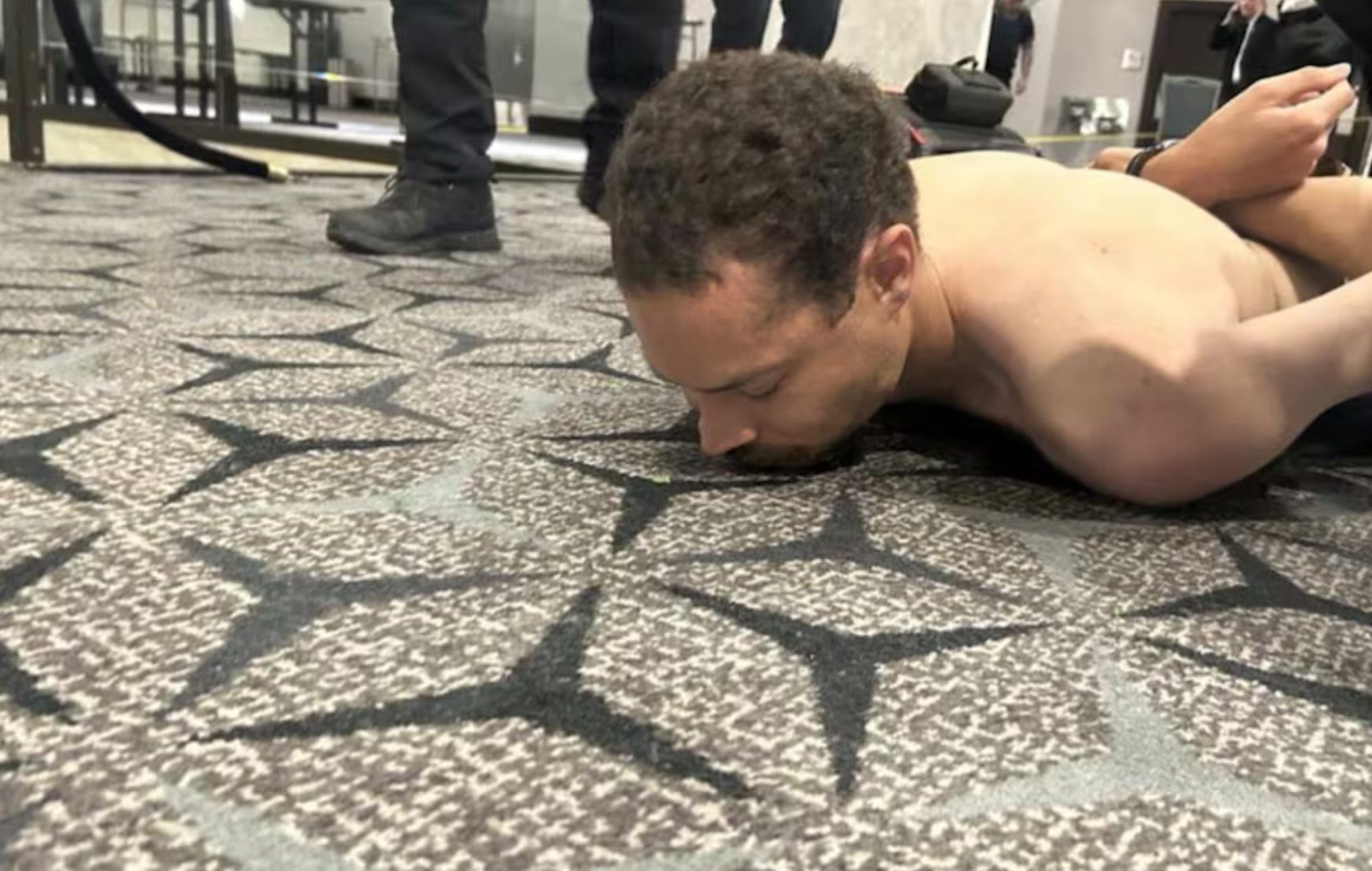
The late nineteenth and early twentieth centuries were punctuated by high-profile assassinations and bombings carried out by lone anarchists, in what was effectively the first historical manifestation of ‘international terrorism.’ These ‘propagandists of the deed’ believed that individual acts of heroic violence could inspire their would-be constituencies to rebellion, whilst also striking terror into their rulers. They killed, expecting to be executed, and they usually were.
In an era of extreme divisions of power and wealth, when progressive political change seemed difficult if impossible to achieve and the urban working classes had yet to find political representation, these anarchist avengers sought to ‘strike a blow to the heart of the state’ and demonstrate with the bomb, the bullet and the knife that even kings, generals and high officials were not invulnerable to revolutionary justice.
Propaganda of the deed did not do the anarchist movement much political good. More often than not, it actively harmed the movement, providing a pretext for state repression, mass arrests, and moral panics. There is no evidence that Cole Tomas Allen, the would-be shooter at the White House Correspondents Dinner was an anarchist, but the manifesto of this self-described ‘Friendly Federal Assassin’ contained something of the spirit of those lone anarchist avengers, with its invocation of intolerable crimes as a justification for his own actions:
I am no longer willing to permit a pedophile, rapist, and traitor to coat my hands with his crimes.
Like Camus’s ‘just assassin’ Kaliayev, Allen justified his response to these crimes in moral terms. He explained that he had chosen a shotgun to avoid killing bystanders, in his attempt to kill Trump and leading members of his cabinet. Though he recognised that he might have to ‘get through everyone’ to reach these targets, he rationalised the casualties that might result on the grounds that ‘most people chose to attend a speech by a pedophile, rapist, and traitor, and are thus complicit, but I really hope it doesn't come to that.’
It is not at all clear how Allen thought it would not come to that, given the gauntlet of security guards who barred his path. Even if he had managed to enter the Hilton ballroom, he would have stood very little chance of reaching the table where Trump was sitting without shooting many other people in his path. In other words, this was a tactically-inept attempt to ‘do something’ by an individual with no military training, no known connection to any political organisation, and no motivation beyond his own disgust and outrage.
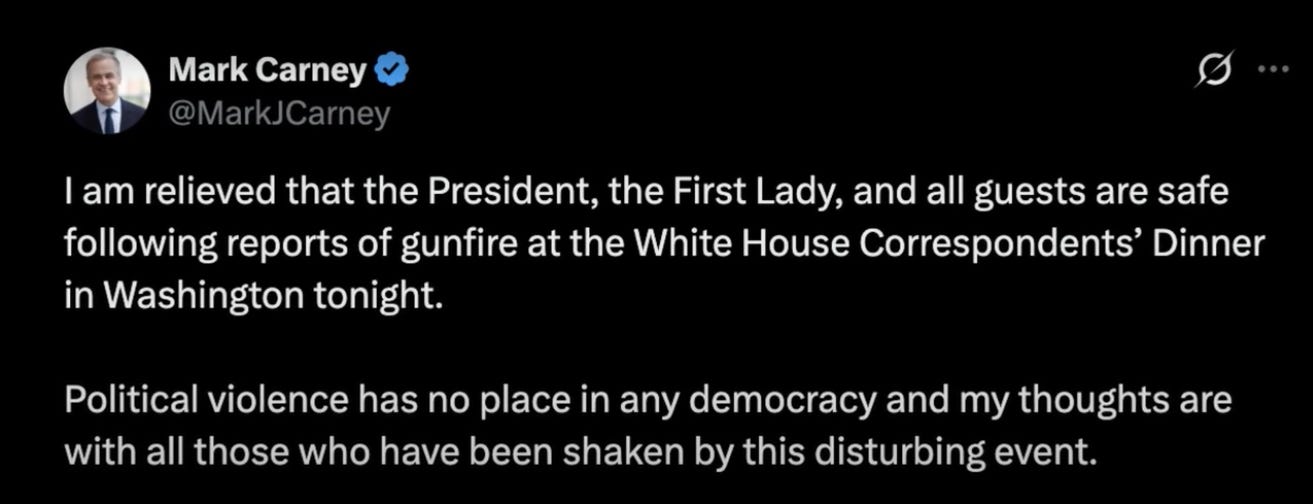
In the wake of this incident, politicians and world leaders rushed to express their solidarity with Trump and his cabinet. Many of them also made a point of condemning Allen’s actions, using the kind of generic language that normally follows terrorist events. The tone was set by Mark Carney:
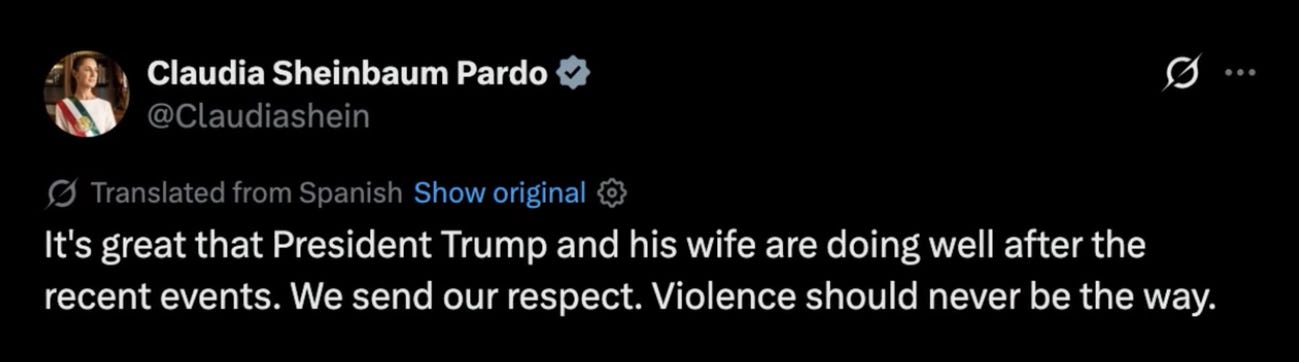
And Mexican President Claudia Sheinbaum:
Narendra Modi also argued that:
Violence has no place in a democracy and must be unequivocally condemned.
Even King Charles told the US Congress that ‘Violence will never succeed’, while Trump’s ex-pal Georgia Meloni added her own variant:
No political hatred should find a place in our democracies. We will not allow fanaticism to poison the spaces of free debate and information.
Kaja Kallas, the EU’s high representative for foreign affairs and security policy, intoned the same message, while also referring to the dinner itself as a quintessentially democratic exercise:
Political violence has no place in a democracy. An event meant to honour a free press should never become a scene of fear.
On and on it went. Meanwhile, Trump’s team basked in this rare glimpse of the moral high ground. Karoline Leavitt accused ‘crazed Democrats’ of whipping up a ‘cult of hatred’ towards the president. Trump condemned ‘dangerous Democrat hate speech’. Both Trump and his wife even suggested that the comedian Jimmy Kimmel was somehow responsible for the attack, because of a joke he made before it had even happened.
This is what these ghouls will always do. Lying, gaslighting, and fake-victimhood come as naturally to them as breathing. But that does not mean that we have to accept the halo they wrap around their monstrous leader. Or the pious ‘violence has no place in a democracy’ platitudes that accompanied last week’s outpourings of diplomatic solidarity.
Because violence may not be ‘the way’, but it is very much part of American way, and of this government in particular. This is an administration that has unleashed shocking violence within its borders against immigrants and the people who defend them. Its members and supporters smeared and mocked Alex Pretti and Renée Good, both of whom were executed by ICE agents in broad daylight.
Trump joked about the attempted killing of Paul Pelosi with a hammer, and sneered at the brutal murders of Rob Reiner and his wife by their own son. He incited a mob to assault the Capitol building in an attempt to overthrow an election, and then went on to pardon its perpetrators.
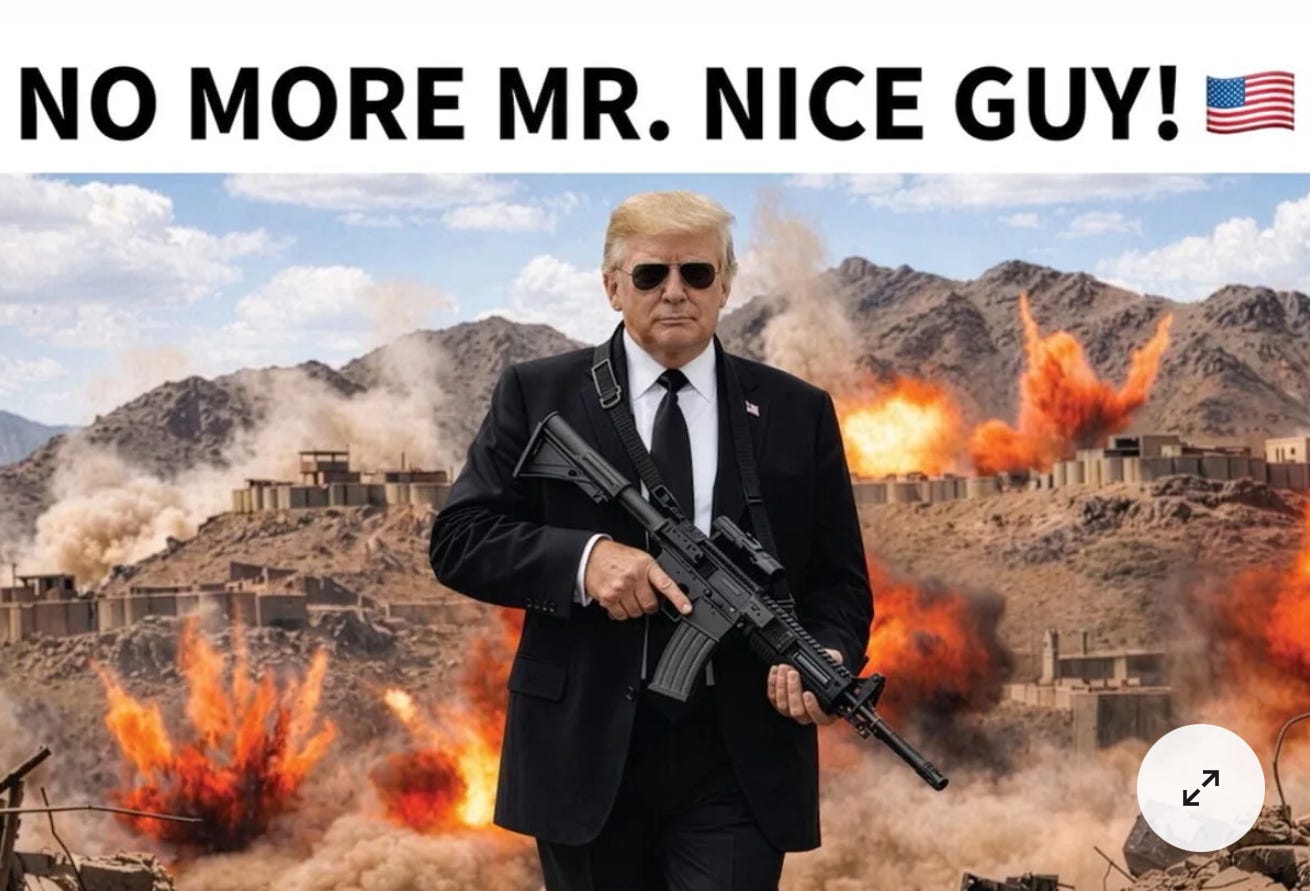
Trump and his henchmen and women have also celebrated the lawless extrajudicial killings of Venezuelan fishermen, and published jokey frat-boy videos about blowing up Iranians and annihilating civilisations. This is what Trump posted last week - a smirking bone spur-meets-Chuck Norris moment that ought to eliminate any lingering doubts that the president of the world’s only superpower is a deranged psychopath:
(Not) Holding Power to Account
The world is still reeling from the effects of a war of aggression instigated by the US and its genocidal sidekick. Yet few of the world leaders who expressed their solidarity with Trump last week have ever condemned the words or the actions of this cruel, lawless administration.
None of these leaders had anything to say about ‘political violence’ when the US and Israeli blew up Iran’s Supreme Leader and his family in an attempt to provoke ‘regime change. ‘ No one raised their voice to defend free speech or democracy, when Israel killed the Lebanese journalist Amil Khalil, in what appears to have been a targeted ‘triple-tap’ strike aimed at eliminating a critical journalist.
Khalil knew that her life was in danger because of work she did, but she refused to abandon it. She lay under rubble for hours, while Israeli troops blocked attempts by emergency services to reach her. Khalil is one of 27 Lebanese journalists killed in Israeli attacks since the start of the war, according to the Lebanese Press Syndicate Editors. In Gaza, the number is 270, including 5 Al Jazeera journalists.
None of these killings - most of which were targeted - have provoked outraged calls to defend press freedom and free speech. But the bravery and commitment of these men and women ought to shame the politicians and court scribes turned out to honour the president who has done more to attack press freedom than any president in American history.
This is a president who has tried to get journalists sacked, gutted some of America’s most illustrious media corporations, launched frivolous lawsuits against any newspaper or media outlet that offends him, and marginalised critical journalists at Karoline Leavitt’s liarday propaganda sessions. Everyone who turned out in a gown and tuxedo last week knew this. All of them knew that Trump tried to overthrow the elected government of the United States, that his name appears thousands of times in the Epstein files, and that he and his associates are guilty of war crimes.
Most of them would have been aware that the legendary CBS News is being turned into a Trump-friendly media outlet under Trump’s pal Larry Ellison and Ellison’s place-woman Bari Weiss. Yet there was CBS White House correspondent Weija Jiang, the president of the White House Correspondents Association, sitting next to the paedophile felon in an evening gown, and telling him ‘It is meaningful that you are here tonight.’
This was true, in the sense that an act of collective self-abasement in the face of tyranny and authoritarianism can be meaningful. But such unifying moments are not anything that America or any other country confronting these forces needs in these dire times.
The White House Correspondents Dinner has always been a bad idea, which embodies everything that is wrong with the US media, and its unhealthily cosy relationship to the powerful. It is true that these backslapping events have occasionally produced - against the will of their organisers- some genuinely subversive moments, such as Stephen Colbert’s cunning 2006 takedown of George W. Bush, or Michelle Wolf’s assault on Sarah Huckabee Sanders in 2018.
But a fourth estate that wants to uphold the First Amendment cannot, and should not, do this by dining out a corrupt, fascistic government that detests the very idea of an independent media, and is actively dismantling the checks and balances that attempt to limit its power.
The Guardian’s David Smith, who also attended the WHCA dinner last week, described how ‘darkness came viscerally close’ during the attempted attack. Smith was wrong. The darkness was already there, amongst the bow ties, the Rolex watches and the glittering necklaces. It has been staring America and the world in the face, even if White House ‘correspondents’ refuse to recognise it for their own convenience, and continue to sanitise it, serve it a bowl of milk, or attempt to appease it in order to maintain ‘access’, or ensure the right to attend Karoline Leavitt’s daily lie-ins.
And it’s in this moral vacuum that men like Cole Tomas Allen can appear, just as they once did in the Belle Epoque. In his manifesto, Allen asked himself if he should follow the Christian notion of ‘turning the other cheek’ and replied to his own question in the negative:
Turning the other cheek is for when you yourself are oppressed. I’m not the person raped in a detention camp. I’m not the fisherman executed without trial. I’m not a schoolkid blown up or a child starved or a teenage girl abused by the many criminals in this administration.
Too many people who ought to know better have normalised the practices that he described, and ignored their victims The White House Correspondents Dinner was a particularly egregious demonstration of that normalisation. ‘Some people are so angry they’re willing to resort to violence. How do we find common ground again?’ lamented MSNBC anchor Katy Tur after the aborted attack.
The answer to this fatuous naïveté is, or ought to be, that ‘we’ are not obliged to find common ground with political evil, and that is what Trump, his minions and his party represent.
So by all means, condemn Allen’s actions, because these forces cannot be defeated by lone acts of political murder, which mimic the cruelty of their intended targets. But we should not pretend that such acts are an aberrant manifestation of barbarism in a peaceful world. The people he intended to kill are responsible for many more deaths than he could have caused, from Iranian schoolchildren, to the millions who will die as a result of Trump’s cuts to USAID.
In an immoral world where the direct and indirect violence of the powerful goes unquestioned and unchallenged, few, if any of the perpetrators of these acts will ever pay a price for them. Allen clearly recognised this, and his manifesto suggests that he had a more developed conscience than many of those who are now wringing their hands about the futility and senselessness of violence.
You may not want to see Trump and his fellow gangsters shot - I certainly don’t. I want them politically defeated, and I want to see some of them in court. But when the people and institutions who ought to hold power to account prefer to invite it to dine with them instead, there will always be those who seek their own forms of justice and nihilistic vengeance.