
Burnham Down the House
The Mysteries of Makerfield

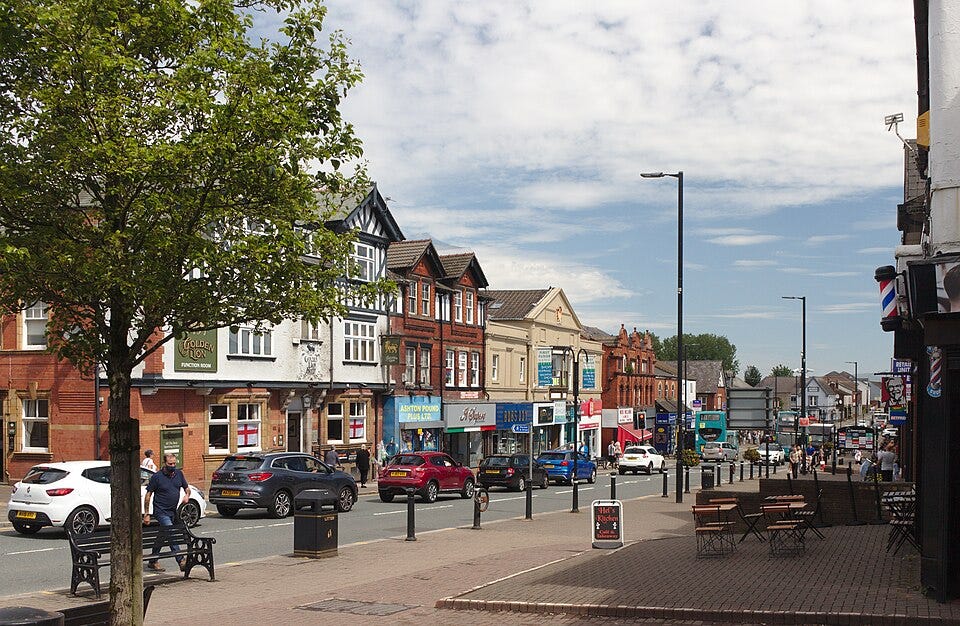
Even by post-Brexit Britain’s giddy political standards, the Makerfield by-election is turning out to be a wild ride. The by-election is only happening because Josh Simons, the former director of the Labour Together group which helped bring Keir Starmer to power, has stood down in order to enable Andy Burnham to ‘drive the change our country is crying out for’.
As everybody knows, Burnham is standing in order to enter a Labour leadership contest that has not yet been announced, and may not even happen, following local council elections in which Labour took a battering - an outcome that has been largely attributed to the electorate’s visceral loathing of Keir Starmer. Burnham’s previous attempt to become an MP was blocked by Labour’s National Executive Committee. This time the NEC couldn’t wave him through quickly enough, apparently with Starmer’s blessing.
Given that Starmer has insisted he will lead Labour in the next election, it is more likely that he is laying down banana skins, rather than palm leaves, for the ‘King of the North’.
Burnham has described the by-election as ‘the most consequential of our lives’, presumably because he sees it as the first step to getting the Big Job. Yet he has been as cagey about expressing such ambitions as he was when he first attempted to run in the Gorton and Denton by-election, preferring to speak in tediously clunkingly broad terms about ‘change’, and change for Labour in particular.
No doubt Burnham doesn’t want to appear arrogant and entitled, and Reform have already accused him of precisely that.
There is a whiff of entitlement in the calls from some of the self-effacing pretender’s supporters for the Green Party to stand down in Makerfield in the national interest, without - as far as anyone knows - offering anything in return. Former Green MP Caroline Lucas - a member of Neal Lawson’s Compass Group - which favours broad tactical voting alliances in order to keep out Reform - has also asked the Greens to do this.
After debating whether to stay out or stay in, the Greens put up a local nurse named Chris Kennedy as a candidate, because, as leader Zack Polanski pointed out, not unreasonably: ‘In a democracy, people must have the choice to vote for the candidate of their choice.’
Within days, the ‘passionate grassroots visionary’, as the party described him, dropped out before being officially announced, following revelations that he shared posts describing attacks on Jewish community ambulances in Golders Green as a ‘false flag’ operation. While the Greens looked for a new candidate - amidst an ongoing discussion as to whether or not to put only limited resources into a by-election that they have very little chance of winning - Reform, came forward with a local plumber named Robert Kenyon as their candidate.
In a campaign video, accompanied by the kind of plaintive orchestral music you might use to accompany a film about the battle of Agincourt, Kenyon describes himself as a humble scion of Makerfield and the North, taking on the public-school educated political class and machine politicians for the simple honour of representing his community. Only the Hovis loaf boy is missing. But then it turns out that ‘the Plucky Pumber’, as Farage calls him, is a friend of some notorious fascists - the old-fashioned kind who like to wear uniforms - and he also turns to be a bit of a racist agitator himself.
It may only be a coincidence that Kenyon has scrubbed his Facebook posts and suspended his X account, following revelations of posts made during the Southport riots in which, according to Byline Times, he ‘become part of a national disinformation network: amplifying Elon Musk, retweeting far-right influencers like Carl Benjamin and claiming that minority communities get more lenient policing.’
It has since been revealed that the Plucky Plumber deleted a second social media account in which he referred to an ‘invasion’ of asylum seekers, promoted Covid conspiracy theories comparing lockdown restrictions to Nazism, and suggested that he would like to sniff and lick Carol Vorderman’s asshole.
This is the kind of candidate that would once have made most parties reach for the bargepole, but in 2026 Britain there are communities who would vote for Oswald Mosley’s reanimated corpse, if it came pushing up through the hard soil covered in dirt, to dance a waltz with Enoch Powell’s remains.
So not only has Reform reiterated its support for Kenyon, but on Friday, who should pop up in Makerfield but Mosley-Farage himself, who managed not to yawn as Kenyon drove him around the area and held forth on the cost of living
Farage is facing financial pressures of a different kind, regarding donations that most plumbers would have to work several lifetimes to earn. He was reminded of these pressures, when a C4 journalist spotted him in Makerfield, and he was forced to flee to avoid answering questions. Hunched alongside Kenyon, he looked distinctly furtive, and watching him trying to show empathy with Makerfield’s hard-pressed constituents was a little like watching Dracula nursing a sick child.
Empathy is not something that comes naturally to Farage and his freak army. In Makerfield, he and his entourage barged unannounced into a community cafe for young adults with additional needs, in what the owner described as an ‘overwhelming and intimidating manner’.
Meanwhile, Restore - Farage’s chief threat from the right - has put up a local businesswoman as candidate, whose first priority is - well it is Rupert Lowe’s party:
Safer streets for women and girls - tackling the gangs of foreign men who harass and intimidate local women and girls in Ashton, and elsewhere across the constituency and the Wigan Borough.
And last, and very much least, the Conservatives - remember them? - have put the former mayor of Wigan, Michael Winstanley as their candidate, who last ran for the seat 29 years ago.
These are the contenders the King of the North must beat in order to make it back down south. In normal times, this would not be a problem in a safe Labour seat, but these are not normal times, and few Labour seats are safe. Starmer has promised to campaign for him - an offer that any Labour politician wanting to gain or hold onto a seat would politely decline right now.
Polls indicate that Burnham is already is more popular than Starmer, but then Rasputin would probably achieve a similar result. Crucially, polls also suggest that he is more popular than Farage, and this personal popularity features regularly in the arguments of Burnham’s supporters.
The logic of their argument is this: by getting rid of an unpopular prime minister in the aftermath of the local elections and replacing him with someone who voters actually like, Labour will be able to rejuvenate and reinvigorate its flailing government, and get Burnham into Downing Street in time to fend off Reform. It’s a happy ending story which requires considerable suspension of disbelief.
Manchesterism
Personal popularity is not the only argument behind Burnham’s advance. In his campaign video, amid the backslapping and contrived accidental encounters with the public, Burnham traces his own political career as a response to the decline of the North, which he attributes to Thatcherite deindustrialisation and deregulation.
He goes on to celebrate the revitalised Manchester under his administration, and makes the bold claim that the political philosophy he calls ‘Manchestersism’ - drawing different meanings from the nineteen century use of the term - represents ‘ the end of neoliberalism, the end of trickledown economics.’ Neoliberalism is not a word that gets used much by the Starmer government - I’m not sure I’ve ever heard anyone in the government use it. But then the North is not a word that gets used much by any political party either, let alone by a politician with a northern accent.
This critique is part of Burnham’s appeal. Burnham has some impressive achievements in Manchester - the most well-known of which is probably the city’s franchised bus service. In a speech in January this year, he laid out ambitious plans to ‘reindustrialise the birthplace of the industrial revolution’ through public-private projects in ‘world-leading innovation clusters’ based round AI, advanced manufacturing, health innovation and life sciences.
Burnham now sees initiatives like this as a model for national governance, based on public control of utilities, targeted investment, localism and devolution, and he also sees them as the antidote to neoliberalism.
In the intellectual famine of post-Brexit politics, it is eyecatching in itself to find any mainstream politician analysing the causes of the UK’s longterm decline, and proposing a set of well-developed ideas to address it. It is also a testament to the narrow limits of permissible British political discourse that Burnham’s mild social democratic proposals have been greeted in some quarters like a call to storm Buckingham Palace and have the Royal Family shot in the basement.
Already the tabloids are rending their clothing and gnashing their teeth, and accusing Burnham of plotting ‘tax raids’, shape shifting, betraying women and anything else they can throw at him. Expect no measured debate from this lot. The bond markets are jittery at the mere suggestion of ambitious and possibly unfunded reforms and renationalisations - assuming that is what Burnham actually means.
How would Burnham deal with the opposition he would inevitably encounter? To whom would he bend, and how far? Burnham has promised to stay within Rachel Reeves’s fiscal rules. Though he calls the UK ‘undertaxed’, he has promised not to raise taxes on the wealthy.
He has insisted on the need for a ‘relentless domestic focus’ in policymaking, but the local, the national and the global are inextricably entwined, and right now the global context is not at all favourable to the schemes Burnham has in mind. Asked in response to Wes Streeting’s prediction that the UK would eventually join the EU, Burnham responded: ‘My view is that Brexit has been damaging, but in my view the last thing we need right now is to re-run those arguments.’
This is thin gruel, which Labour politicians have been serving the public for a long time, and it will not revitalize an ailing nation that knows it made a poor decision but lacks the courage and the honesty to change it. Burnham’s stance is a reflection of this paralysis. Burnham has also supported Shabana Mahmood’s draconian immigration proposals, which even Angela Raynor called ‘un-British.’ No such criticisms from Burnham, whose sources claimed:
For Andy, migration is a moral issue as much as anything, showing people who’ve lost faith in politics that we do have control and we can do good
And
We need to tell a positive story about the contribution of migration to our country, but we cannot do that unless people trust that the people they vote for have control over our borders.
Once again, Labour politicians have been making this ‘strong borders/greater trust’ argument for the last 26 years, as a justification for adopting harsh immigration proposals normally associated with the right and far-right. There is no evidence of any trust dividend, and ‘positive stories’ about immigration have been conspicuous by their absence.
Burnham may be supporting Mahmood in order to fend off the ludicrous ‘open borders Andy’ accusations thrown at him by Farage, which may be strategic, but doesn’t exactly make him ‘moral’. And consider this exchange from an interview with ITV:
Interviewer: Do you understand why people are voting for Reform?
Burnham: 100%. Because my party and other parties have let them down….we’ve got to a point where life has become unaffordable, and the status quo hasn’t delivered for them. And they’re sending a message, aren’t they? And rightly, in my view, this just isn’t good enough…and it’s time for politics to respond to that message.
Interviewer: And what do you make of Nigel Farage?
Burnham: I’ve only met him a couple of times, and he was perfectly friendly.
Interviewer: As a politician?
Burnham: He’s clearly effective. I just don’t agree with him.
This is not clever politics, but political cowardice. There is not the slightest attempt to address the threat that Reform poses to the UK and to minorities across the country, or the type of society it wants to create. How should ‘politics’ respond to the ‘message’ that Reform voters are sending? Is there any more to Farage - his funding for example - that explains his ‘effectiveness’?
Like his party, Burnham appears so frightened of losing voters to Reform that he cannot even bring himself to make a serious critique of his main political opponent and the movement he represents.
Such a supine response does not bode well, if Burnham is ever called upon to face the likes of Trump and Netanyahu.
It might be that Burnham wins, and finds his way through the labyrinth that leads to Downing Street. If he succeeds, it’s possible that his popularity, coupled with some of the more viable ideas that he has developed in Manchester, will give Labour enough of a boost to see off Reform.
But it may also be that a leadership contest described by David Edgerton in the New Statesman last week as ‘driven by personalities and vibes’ confirms the Labour Party’s desperation and decay. Burnham could lose to the toxic plumber before he gets anywhere near Westminster. And if Burnham does get into Downing Street, he may be so constrained and nailed down, that the only noticeable difference between him and Starmer is the accent, in which case the ‘change election’ will have been for nothing.
I raise these possibilities not because I want to be unduly negative, but because it will take more than platitudes and a more relatable leader to pull this country out of its current self-destructive spiral. If Burnham can galvanise Labour to become better than it has been, then good, but I’ll believe it when I see it. In the meantime, I’ll wait and see what happens on June 18, when the voters of Makerfield decide whether this weird by-election is the beginning of Starmer’s end, or the end of Burnham’s beginning.
The 'sophisticated' political approach, we are told, is to adjust your principles according to the current of popular sentiment so that you can gain access to the levers of power. But, after the past 20 years of this, all that has been achieved is to make politicians more despised than journalists and estate agents (possibly even than 2nd hand car salesmen). Why? I think there are two reasons. The first and most obvious is that it means that what we get is not what we think we are getting (so far, so estate agent/2nd hand car dealer). The second, more subtle reason, is that on the whole we respect people who stick to their principles, even if we don't necessarily agree with them (within limits obviously) but we tend to despise those that change them to 'fit in'.
The grown-up centrist approach we are always being told about, involves making vague promises that things will get better, and pandering to whatever is fashionable or popular in a sort of dad-dancing way (including 'softened' anti-immigrant 'stop the gangs to stop the boats' rhetoric to try to score points with liberals and xenophobes). The net impact of which is that things continue to slide for many, so they end up not trusting anyone in authority and supporting those who say the strong/nasty stuff out loud.
If Burnham is going to pursue this same path to power, at best he might stop the complete collapse in Labour support, and we'll end up with some sort of hung parliament. At worst, he'll continue the parabola into disaster and authoritarianism. But to go against the weight of the existing structures of power and privilege to enact real change that would make a positive difference he needs courage, integrity, nerve, solid principles, and support. It is the last that is going to be in short supply in Parliament. The majority there are placemen and sell-outs who know which side their bread is buttered (to use an old expression).
I’ve been in the constituency today canvassing for Labour. Initially worrying to see a group of 10 Restore canvassers, however they were stuffing leaflets into letterboxes but not door knocking. I’m not sure whether they ran into the Sikhs for Labour team.
Plenty of Reform leafletting, but their candidate’s social media idiosyncrasies are being noticed.
I spent half an hour with a young couple who don’t normally vote but had lots of questions about Labour policies and why things are as they are; I was very grateful for the cup of tea given the heat🥵