
Black Rain
Destroying Tehran in Order to Save It

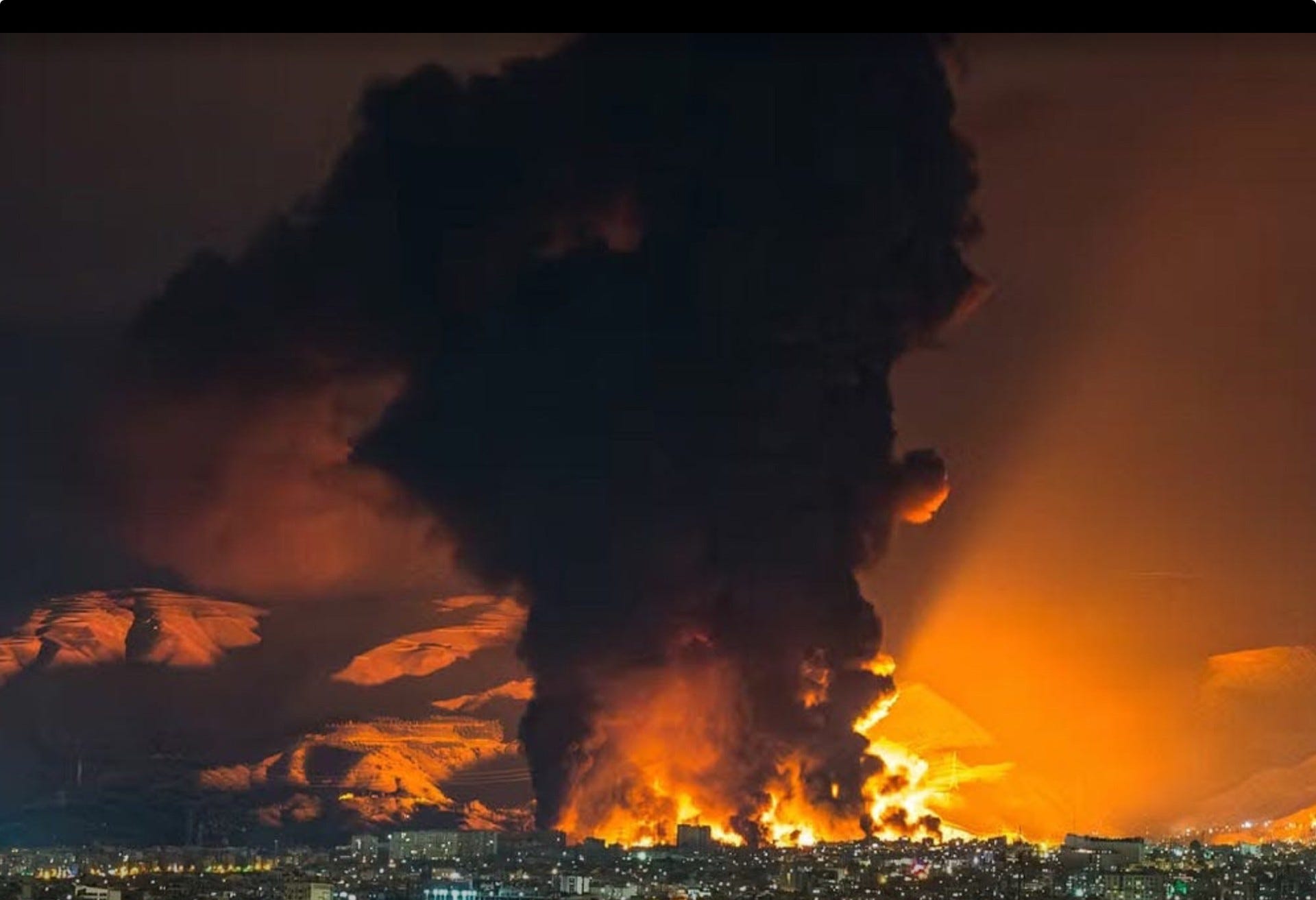
It seems a long time ago now, but it’s little more than four months since drought-stricken Tehran was in danger of running out of water. In October, the Iranian president Masoud Pezeshkian announced a proposal to re-locate the entire population of Tehran to the south of the country - an impossible logistical task in a water-stressed country.
At the beginning of December, the Bulletin of the Atomic Scientists warned that a combination of negative environmental factors had brought the Iranian capital to the brink of ‘Day Zero’ when the water taps would run dry. That month, the autumn rains brought the city some relief. But now the US-Israeli airstrikes are pushing the Iranian capital closer to the brink of a catastrophe it may not be able to come back from.
Last Sunday, in one of the most shocking acts of this atrocious war, Israel bombed fuel depots and oil refineries in and around Tehran, creating a toxic cloud of ‘black rain’ that stained cars, balconies and pavements with acidic slime. Oil and petroleum also found its way into the city’s gutters, igniting rivulets of burning fuel.
As a result, an urban population of just under 10 million people was exposed to a cocktail of hydrocarbons and carcinogenic toxic pollutants that the World Health Organization (WHO) warned has the potential to cause chemical burns and lung damage. The WHO told residents to stay indoors, to avoid rain contacting skin, but many people don’t have that choice, such as the school teacher who told Time:
Today I was in the car for just 15 minutes, breathing this air. I don’t even know what it is, and now I have a headache. The skin on my face, especially my lips, is sore and raw. It burns and feels like diluted tear gas is in the air. It irritates my eyes, and I keep needing to clear my throat.
This acidic rain also has the potential to leach into waterways, reservoirs and aquifers, creating a health and environmental crisis that will linger long after this war ends. Whoever ordered these strikes must have known what their consequences would be, yet they believed that poisoning the population of a city almost as large as London, and potentially destroying its water supply, was a price worth paying..
On 10 March Netanyahu had the temerity to tell the ‘People of Iran’ on X that ‘we are fighting a historic war for liberty.’ Netanyahu described the war as a ‘once in a lifetime opportunity to overthrow the Ayatollah regime and gain your freedom’, and boasted that Israeli and the United States were ‘hitting the tyrants of Tehran harder than ever.’
Beyond the propaganda, it is by no means clear that the US-Israeli strikes are making any distinctions between the regime and the population. On Friday, the Guardian quoted a 66-year-old retired professor in Tehran who described how:
The buildings are shaking … There’s rubble everywhere and people are still risking their lives to go to work. Please stop this. I am begging the world to act now before the entire city is destroyed. I can’t leave the city, and have sick family members. Even those who want to flee, can’t. They are not giving us enough petrol to even drive far enough. We are trapped.
In a powerful piece written for the Ajam Media Collective, Nazanin Shahrokni, Associate Professor of International Studies at Canada’s Simon Fraser UniversIy, evoked the city of her youth, in which her friends and family were trapped:
The city that some members of the diaspora had long called ‘a ruin already’ …was never rubble. It was suffocating at times, chaotic, uneven, but stubbornly alive—restless, inventive, full of motion and possibility. War has a way of fulfilling fantasies of destruction that language alone never could. The bombs are doing what rhetoric once claimed. Turning neighborhoods into the ruins others had already imagined.
Writing for the New York Times on 2 March, Farnaz Fassihi described how these ruins were being created:
Rows of apartments near collapse. Block after block littered with mangled metal, shards of glass and shreds of paper. A hospital room with its windows blown out, bricks and debris covering the bed.
Last Monday, three mid-rise apartment buildings in Resalat Square in eastern Tehran were bombed in successive strikes. Dropsite News described the aftermath:
The building facades had been blown away. Balconies had collapsed. Windows shattered. Rubble was everywhere. Inside, where families lay buried under the broken concrete, screams began to fill the air. At least 40 people were killed, according to official reports. Most of the victims were civilians who had been inside their homes when strike hit.
The same is happening all over Iran, in more than 15,000 strikes whose targets include schools, hospitals, shops, businesses, sports stadiums and historic buildings. At least 1,348 Iranian civilians have been killed, over 17,000 injured, and 3.2 million people have been internally displaced. UNESCO World Heritage Sites in Tehran, Khorramabad, and Isfahan have also been damaged by the defenders of civilization.
In Lebanon, the destruction has been equally apocalyptic. More than 800 Lebanese have been killed, including entire generations. Towns and urban neighbourhoods have been obliterated, and an astounding 800,000 displaced. On Wednesday, Israel carried out a double tap strike, which killed eight displaced people who had been sleeping in tents on the seafront. On Friday night, Israel killed 12 medical staff in southern Lebanon. For the umpteenth time, Israel has reduced whole swathes of southern Beirut to rubble:
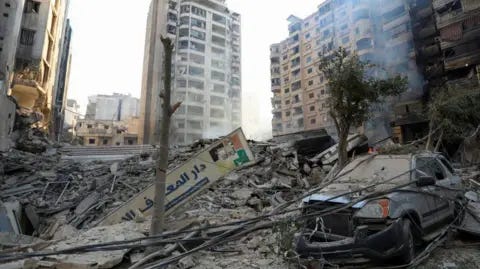
The Lebanese Health Minister Rakam Nassereddine accompanied a request to the international community to send surgical kits and and first aid kits, whilst adding:
The main call is to stop attacking civilians and to stop attacking the medical services, medical sector and ambulances.
Such appeals are likely to fall on deaf ears, just as they did when Gazans made them. Iran and Hezbollah have also attacked civilian targets in the Gulf and in Israel - there are no good guys here. But there are aggressors. Israel and the United States launched this war of choice, and both countries are able and willing to inflict levels of devastation beyond anything Iran’s asymmetrical warfare can match.
Both countries have air superiority, and they also have well-established tactics and strategies for using it, and this is why the destruction we are witnessing in Iran and Lebanon seems horribly familiar. If you think that we have been here before, it’s because we have, many times.
Urbicide
In 1996 the writer Marshall Berman coined the term ‘urbicide’ to describe the urban development strategies that wrecked the South Bronx in the 1960s and 70s. In military terms, the concept of ‘killing cities’ can be traced back to the Old Testament, to the devastation of Carthage in the Third Punic War, to medieval sieges, to the destruction of cities during World War II, where US bombing strategists in Utah prepared for the bombing of German cities by recreating mock-urban targets in which even the precise curtains and toys used in German homes were chosen to see how quickly incendiary devices could burn them.
More recently, geographers such as Stephen Graham and Derek Gregory have analysed the ways in which cities became the paradigmatic battlefields of the ‘war on terror’. This ‘new military urbanism’, as Graham called it, envisioned the ‘systematic devastation of technology and infrastructure’, as a ‘form of demodernization’ in which bombs and missiles reduced entire cities to an earlier stage of economic and technological development.
Beginning in the 1999 Kosovo war, cities were targeted in successive conflicts in order to bring about or at least threaten this outcome. Attacks on vital urban systems such as transportation networks, medical facilities, water treatment plants and the electrical grid, effectively presented adversaries with a choice: surrender or be bombed back into the ‘Stone Age.’
During the two US sieges of Fallujah in 2004, soldiers fired on ambulances and hospitals and burned insurgents to death with white phosphorus, in order to conquer the city. In December that year, the New York Times Erik Eckholm visited Fallujah and found ‘a desolate world of skeletal buildings, tank-blasted homes, weeping power lines and some palm trees.’ For years doctors in Falkujah have reported high numbers of malformed babies, which they claim are due to the weapons used by the US military in the battles of 2004.
Similar methods were used during the assault on Ramadi in 2006, where US forces demolished eight city blocks and bombed the power station, water treatment facilities and water pipes. Israel has also targeted urban infrastructure and vital life support systems in its wars in Lebanon, Gaza and the West Bank.
Once again, such devastation is not unique to Israel or the United States. The Russian assault on Grozny; the Syrian-Russian bombings of Aleppo and other rebel-held cities during the Syrian civil wars; the ongoing Russian attacks on Ukrainian cities - in all these cases, armies have employed their own destructive variants on ‘military urbanism.’
Nevertheless, the US military is unique, in its global focus on the city as the key strategic challenge of the twenty-first century and the most likely obstacle to its megalomaniacal goal of ‘Full Spectrum Dominance.’ This was a departure from the Cold War, when American military planning oscillated between mutual assured destruction scenarios of nuclear warfare and rural counterinsurgency.
With the advent of the ‘war on terror’, and the Iraq insurgency, US military planners returned repeatedly to the idea of the city - particularly the ‘feral cities’ of the Third World and Middle East - as decisive battlegrounds in the wars they imagined fighting. From drug cartels in Mexico City to terrorist-held neighbourhoods in Iraq, the Pentagon has repeatedy depicted the world’s cities as the worst places on earth, and rehearsed how to use air power to dismantle them, and how to fight inside them.
To some extent, these objectives were shared by the Israeli military, which has its own traditions of urban war fighting in successive wars in Gaza and Lebanon. In 2008, General Gadi Eizenkot articulated what became known as the Dahiyeh Doctrine, following the Israel devastation of Beirut’s Dahiyeh neighbourhood during the 2006 Lebanon war. Eizenkot saw Dahiyeh as a template for future operations, in which Israel would ‘wield disproportionate power and cause immense damage and destruction’ in response to any Shi’ite village from which shots were fired at Israeli troops.
This doctrine was not entirely new. Collective punishment - including the destruction of homes, towns and villages - had been built into the Israeli counterinsurgency model for decades. Artillery and aerial bombardment has long been seen by the IDF as a strategic weapon, to turn civilian populations against the armed organisations in their midst.
The Dahiyeh Doctrine differed from its previous incarnations its explicit embrace of limitless destruction as an instrument of persuasion and dissuasion, with the aim of ‘inflicting damage and meting out punishment to an extent that will demand long and expensive reconstruction processes.’
There was also another dimension to this devastation. According to the Israeli sociologist Yagil Levy - a former IDF officer who has studied the evolution of the Israeli armed forces - the IDF prioritised a new military model following its withdrawal from Lebanon in 2000, based on the ‘transfer of risk from soldiers to enemy civilians.’ This ‘transfer’ entailed tactics such as:
an aggressive fire policy that includes aerial strikes authorizing collateral damage—namely, the killing of civilians—on an unprecedented scale; extensive use of artillery fire and the systematic demolition of buildings at the entry points to populated areas; the creation of ‘sterile killing zones’ in which any man entering a defined space is deemed a legitimate target; rules of engagement that leave little room for doubt or discretion…. The result has been an extremely heavy civilian death toll in Gaza.
If this war continues, there will be an extremely heavy civilian toll in Iran and in Lebanon. And it is this kind of thinking, not the depraved and flippant bloodlust of Pete Deathshead (no typo) or his mad, stupid emperor, that now threatens to destroy Beirut and Tehran. As Israeli Defense Minister Israel Katz warned last week:
The Lebanese government, which misled and did not fulfill its commitment to disarm Hezbollah, will pay increasing prices through damage to infrastructure and the loss of territory, until the central commitment of disarming Hezbollah is fulfilled.
This is not just a threat of destruction and territorial conquest; it is incitement to civil war, and there are clearly those in Israel and the United States who would like to see either outcome in Iran. Surprised by the resilience of the leadership they thought they had decapitated, there are no limits to what these ‘liberators’ are prepared to do.
What is astonishing is how normalised this has become. Many commentators have criticised the ‘chaos’ of Trump’s war, its lack of strategy and an ‘off-ramp’, while tempering their mild criticisms with headshaking condemnations of Iran and its ‘loathsome’, ‘terrorist’ regime, and reminders that it cannot be allowed to threaten Israel’s right to exist etc, etc.
Few point out that it is Israel, not Iran, that has nuclear weapons, as does the United States, and that Iran would be annihilated within minutes if it had a nuclear bomb and dared to use it. Few ask why Trump wrecked the agreement that was already in place in 2018.
A number of governments have criticised Iran’s ‘reckless’ attacks on its neighbours. Few have commented on the recklessness of blowing up oil refineries and desalination plants in Iran. Or the destruction of homes and entire communities in Lebanon. It’s easy to be revolted when the likes of Deathshead and Lindsey Graham exult in America’s capacity for death and destruction, or when Trump promises to blow up Kharg Island ‘just for fun.’
Such men are the scrapings of humanity. But the sickness of America’s current crop of leaders does not explain why Iranians are trapped between a regime that kills them if they protest and two countries that will continue to bomb them if they don’t. Gordon Brown wrote last week that the US strikes on an elementary school in Minad had ‘shaken the conscience of the world.’
The truth is that ‘the world’ - or at least most of the governments who run the world - has no conscience, as far as Israel and the United States are concerned. And this is why every US-Israeli war feels like Groundhog Day. As Gaza has already shown, only the level of devastation changes, and even when it turns toward total annihilation, too many governments are more alarmed by those who protest such devastation than they are by the destruction itself.
This is why black rain fell on Tehran last week. It is why Lebanon is being torn to pieces. And until ‘the world’ calls out this violence for the horror that it is, and treats its perpetrators with the same indignation normally reserved for ‘rogue states’, the bombs will continue to fall, regardless of who is in the White House.
Because as long as we live in a world in which a handful of powerful states who happen to be ‘our’ allies are allowed to reserve for themselves the right to destroy cities in order to save them, as one US officer said of Hue during the Vietnam war, there will be no peace and no justice.
And cities - even cities of 10 million people - will continue to be bombed into the Stone Age by those who, to paraphrase Tacitus, would make a wasteland and call it liberation.
It's hard to know where even to start with these people. They have said out loud so much already that would incriminate them in any genuine war crimes court. In that they are beyond many of the worst autocrats of the past who were at least bit more subtle.
Israel is lost, with the overwhelming majority of the population aligned with the government's murderous actions, if not with Netanyahu personally. The likes of Haaretz, +972 and Btselem being lone but extraordinarily brave voices. It has alienated all but a very few countries, along with many of its traditional liberal supporters who have been deeply insulted when wholly legitimate criticisms of Israels actions are dismissed as just anti-Semitism. Another generation of young people whose family and friends have been slaughtered by Israelis will grow up hating Israel. And by extension hating the wider Jewish community in whose interests Israel claims it is acting
America has a greater number of opponents of the Trump regime compared to Israel, but it's not a majority in terms of those active, and the leadership is negligible. Across politics, business, military, media and the rest too many have thrown their lot in with Trump. They share the guilt. Its institutions have been massively weakened and will take many years to recover, if ever. It will never be the same as it was and its erstwhile allies are showing every sign of having moved on. Tactically they will work with the US as best they can but they are now planning for a future in which the US is at best merely obstructive, but may well be actively interfering with the interests of the UK, Europe and their genuine allies.
China and Russia are the ones celebrating.
What is truly shocking to me is that Israel makes no attempt to hide its methods. They are clear and obvious. The deliberate targeting of civilian infrastructure, especially health, education and sanitation. The relentless destruction of the built environment. The assassinations of anyone in a leadership position to ensure that there is nobody to hold peace talks with, or to "come to terms" with - because they have no wish to do so. They just want to kill anyone that resists or opposes them, or make their lives unbearable by destroying and degrading everything they depend upon, even if that resistance or opposition is merely to exist in defiance of their campaigns of extermination. The fact that Hamas still exists, and that Palestinians are still living in Gaza is a provocation to the zionist supremacist death-cult that Israel has become. The same will be true of Iran. They cannot stop the killing because that existence as resistance will not stop. The only way it ends is if others force them to stop. But...who will?
Israel cannot win in the long term. The idea that a nation of 9 million can thrive surrounded by hundreds of millions of people that would be required to live in permanent fear, occupied or subjugated, oppressed and controlled with the most sophisticated yet brutal AI surveillance and domination, and terrorized by the threat of extreme violence and uncontrollled destruction at the merest hint of resistance, is preposterous. Yet that is the Zionist plan. A Jewish ethno-state that sees all other races, ethnicities and religions as inferior, and as potential enemies and victims, with no rights, to be treated with no mercy or justice. Justified by their certainty of being God's chosen people, fed on a selective reading of history, carefully cultivated to generate permanent paranoia through the elevation of a sense of unique victimhood to a national obsession. You can see it in how they react with outrage at the suggestion that a genocide could happen to anyone else, let alone that they could be perpetrating one. Even the accusation that they are killing children, rather than being denied, is taken as evidence of antisemitism - despite there being thousands of documented instances of such killing, on a huge scale, over many years.
This intense sensitivity is made catastrophically deadly by promoting a view of Palestinians and other groups as both irrationally antagonistic and less than human. As vermin whose existence is a threat, and who therefore must be exterminated. It is an ideology crafted by genocide to be perfectly designed to commit genocide. Not once, but again and again. It is the inevitable output of the system that has been created. Only a movement from within Israel can break the hold of this death-cult. But this seems a vain hope.